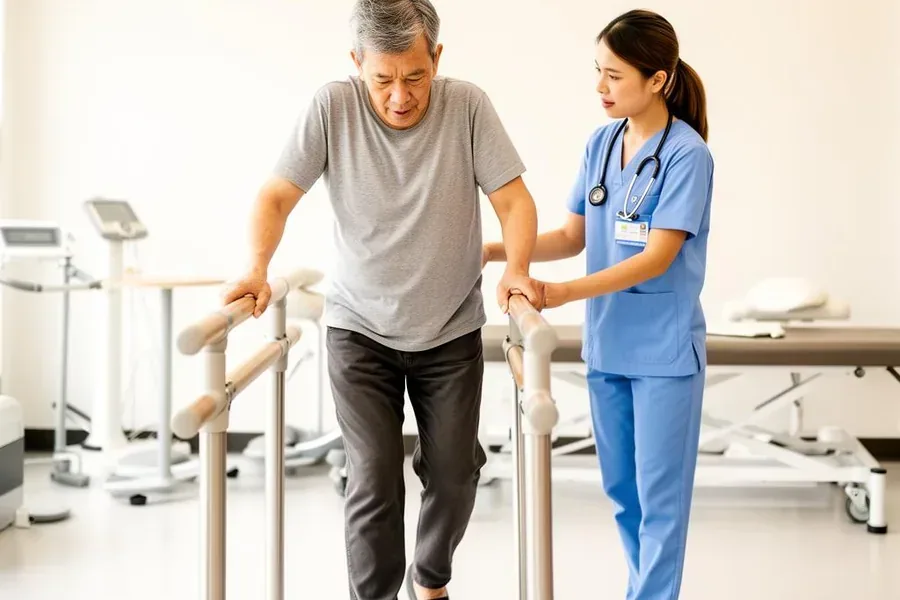


Quick Answer
Match the setting to the stage. In the first weeks after a stroke, when the patient still needs help with transfers, feeding or swallowing, a hospital-based inpatient rehabilitation programme with daily PM&R oversight and two to three therapy sessions per day gives the highest return. Once the patient is largely independent, outpatient or home-based therapy is appropriate. In Bangkok, inpatient stroke rehabilitation at Sanpiti starts from THB 65,900 per month, with technology sessions and specialist consultations itemised separately.
1. The Four Care Settings in Bangkok
Understanding the categories prevents costly mismatches:
- Acute hospital rehabilitation ward — highest medical intensity, usually short stays
- Hospital-based inpatient rehabilitation centre — daily intensive therapy with 24-hour nursing, designed for weeks to months
- Nursing home — long-term supportive care, limited therapy dose
- Outpatient clinic or home visits — suitable once the patient is safe and mobile at home
2. Start with the Patient, Not the Facility
Three questions decide the setting. Can the patient transfer from bed to chair without two people? Is swallowing safe? Is there a medical issue still being actively managed, such as uncontrolled blood pressure, a feeding tube or a tracheostomy? If any answer is concerning, an inpatient programme with on-site nursing and physician review is the safer and more productive choice.
3. The Site Visit: Twelve Minutes That Tell You Everything
Visit during a weekday morning when therapy is running. Look at the gym, not the lobby. Count how many patients are actively training versus sitting. Ask to see a real weekly schedule and a redacted progress report.
- Is therapy one-to-one, or one therapist supervising a group?
- Are patients being walked in corridors, or only treated on a plinth?
- What is the overnight nurse-to-patient ratio?
- How quickly can the patient reach an acute hospital if they deteriorate?
4. Verify Credentials and Specialisation
Ask for the supervising physician\u2019s specialty and licence number, and for therapist licences. At Sanpiti the programme is built around rehabilitation medicine oversight and stroke-specialised physical therapists, led by PT Kultinee Klinpoon (PT licence 9032) and Dr. Korawlai Klinpoon (MD licence 53552), across nine branches serving more than 5,000 families over ten years.
5. Understand the Real Monthly Cost
Compare total monthly cost, not headline rates. Ask which of these are included: room and meals, 24-hour nursing, daily therapy sessions, physician review, nappies and consumables, physician-ordered technology, imaging and specialist consultations. At Sanpiti, inpatient stroke rehabilitation starts from THB 65,900 per month covering the suite, nursing care and daily PM&R oversight, while TMS, PMS, ESWT, imaging and specialist consultations are itemised so the monthly invoice stays predictable.
6. Logistics for International Families
Bangkok is straightforward for medical travel, but plan the details before admission: airport-to-centre medical transfer, visa duration versus expected length of stay, insurance pre-authorisation, medical records and imaging in English, and a nominated family contact for weekly video updates if relatives remain overseas.
7. What a Good Programme Commits To
Before you sign, ask the centre to state in writing the weekly therapy hours, the assessment schedule, the named physician responsible, the discharge criteria and the itemised cost estimate. A programme confident in its outcomes will provide all five.
Frequently Asked Questions
What is the best stroke rehabilitation hospital in Bangkok?
The best choice depends on the patient’s stage and medical needs. For patients still dependent in transfers or feeding, a hospital-based inpatient programme with daily PM&R oversight, 24-hour nursing and two to three therapy sessions per day produces the most functional gain. Compare centres on therapy hours, specialisation and measured outcomes.
How much does stroke rehabilitation cost in Bangkok?
At Sanpiti, inpatient stroke rehabilitation starts from THB 65,900 per month, including suite accommodation, 24-hour nursing and daily PM&R oversight. Technology sessions such as TMS, PMS and ESWT, plus imaging and specialist consultations, are billed separately and itemised.
How long should a stroke patient stay in inpatient rehabilitation?
The average inpatient stay at Sanpiti is about 2.6 months. Patients with mild deficits may need less, while those with severe hemiplegia or dysphagia typically benefit from a longer intensive block followed by outpatient follow-up.
Do the therapists speak English?
Yes. Sanpiti provides English-speaking clinical staff for international patients, including during therapy sessions and family briefings, along with English medical documentation.
Can we transfer directly from another hospital in Bangkok?
Yes. Send the discharge summary, current medications and imaging for review. The rehabilitation physician assesses suitability and the team arranges medical transfer and admission, usually within a few days.
Plan the Move to Intensive Rehabilitation
Share the discharge summary and current function level. We will return a proposed therapy schedule, expected length of stay and an itemised cost estimate for your family to compare.