

Quick Answer
Recovery is fastest in the first 3-6 months, but it does not stop there. Weeks 1-4 are about medical stability and preventing complications. Months 1-6 are the highest-yield window for intensive daily therapy. After 6 months, gains continue but require higher training intensity. The single variable families control most is how many hours of quality therapy their relative receives each week.
1. Weeks 1-2: Stabilise and Prevent Setbacks
The acute hospital focuses on survival, imaging and secondary prevention. For the family, this phase is about avoiding the complications that quietly cost months of recovery later: aspiration pneumonia, pressure sores, shoulder subluxation, contractures and deconditioning. Ask for a swallowing assessment, positioning plan, and early mobilisation from day one.
- Confirm whether swallowing has been formally assessed before oral feeding
- Ask how often the patient is repositioned and mobilised out of bed
- Request a physiatrist (PM&R) review to plan rehabilitation, not just discharge
2. Weeks 2-6: The Decision Point Most Families Miss
Discharge from the acute ward is not the end of treatment — it is the moment the rehabilitation pathway is chosen. Going home with occasional outpatient visits typically delivers a few hours of therapy per week. Inpatient rehabilitation delivers that in a single day. Because the brain is most responsive now, this choice shapes the entire trajectory.
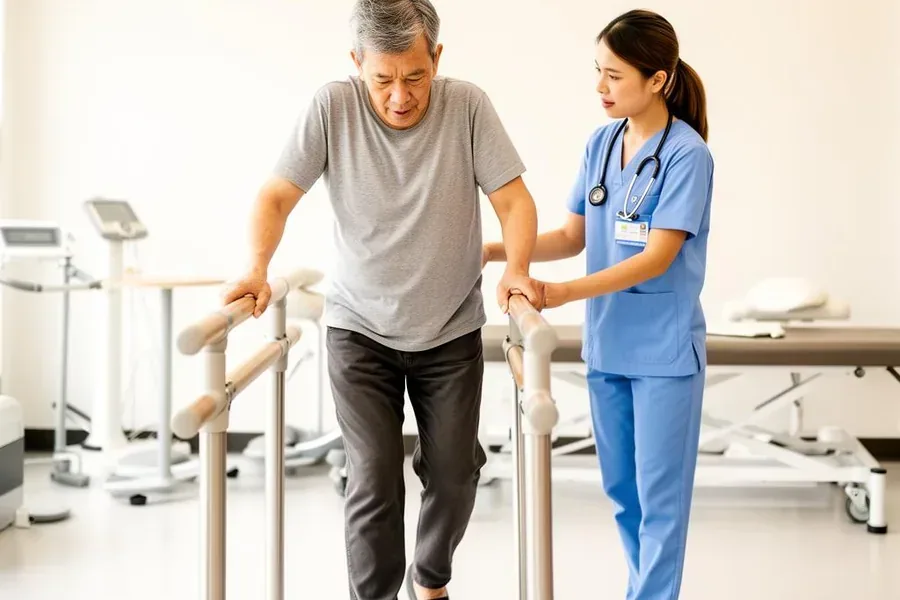
3. Months 1-3: Where Function Returns Fastest
Most measurable gains in sitting balance, transfers, standing and early walking occur here. Progress should be tracked with objective tools, not impressions — Barthel Index for daily activities, Fugl-Meyer for motor control, and gait speed for walking. Expect visible weekly change if therapy dose is adequate.
- Two to three therapy sessions per day, six days a week
- Objective reassessment every two weeks with the family present
- Goals written in daily-life terms: toilet transfer, feeding, 10-metre walk
4. Months 3-6: Consolidation and Independence
The focus shifts from producing movement to using it reliably at home — stair negotiation, bathroom safety, dressing, community walking and returning to work where possible. This is also when spasticity, shoulder pain and mood changes typically need active management rather than watchful waiting.
5. After 6 Months: Slower, Not Finished
Recovery does not have an expiry date. Chronic-phase patients still improve, but spontaneous recovery no longer assists, so training intensity must rise. Structured blocks of intensive therapy — rather than sporadic sessions — are what produce further change.
6. What Families Should Do at Each Stage
The practical family checklist across the whole timeline:
- Keep one written record of assessments, medications and therapy hours
- Ask for the weekly therapy dose in hours, not the number of "programs"
- Learn two or three home-carry-over exercises from the therapist each week
- Plan the home environment early: bathroom grab rails, bed height, ramp access
- Protect the caregiver — rotate duties before exhaustion forces an unplanned decision
Frequently Asked Questions
How long does stroke recovery take?
Recovery is fastest in the first 3-6 months, continues more slowly afterwards, and can extend for years with intensive training. There is no fixed endpoint; the pace depends on stroke severity, complications and therapy intensity.
When will my relative walk again?
Many patients with preserved trunk control and some leg movement begin assisted walking within the first 1-3 months of intensive rehabilitation. Prognosis depends on lesion size, sitting balance at 2 weeks and therapy dose, so ask the rehabilitation physician for a case-specific estimate.
Is it better to go home or to an inpatient rehabilitation centre?
If the patient still needs help with transfers, feeding, toileting or has swallowing difficulty, inpatient rehabilitation in the first months delivers far more therapy hours than home-based outpatient visits and reduces complication risk.
How do we know therapy is actually working?
Ask for standardised scores such as the Barthel Index, Fugl-Meyer assessment and gait speed, repeated every two weeks. Objective numbers show progress or signal that the program needs changing.
What does inpatient stroke rehabilitation cost in Thailand?
At Sanpiti, inpatient stroke rehabilitation starts from THB 65,900 per month, covering the room, nursing care and daily PM&R oversight. Advanced technology such as TMS, PMS and ESWT, imaging and specialist consultations are itemised separately so the invoice stays transparent.
Not Sure Which Stage You Are In?
Send us the discharge summary and current function level. Our PM&R physician and stroke-specialised physical therapists will map the realistic next 90 days for your family.