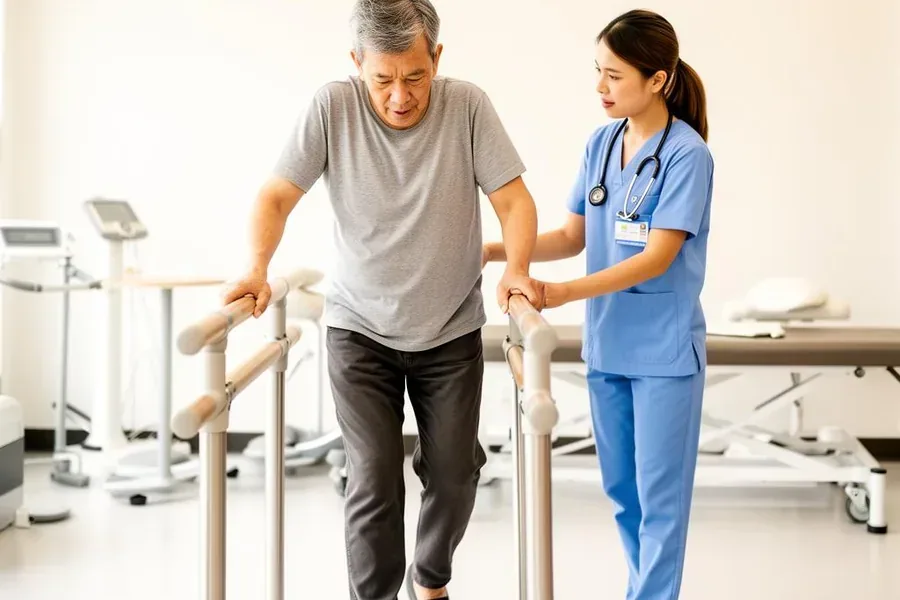

Stroke Rehab Bangkok: Inpatient vs Outpatient
After hospital discharge, who will help with transfers, meals and toileting when the therapy appointment ends? Compare a residential rehabilitation stay with outpatient visits and rehabilitation at home—not just the equipment or number of sessions.

Quick answer
Inpatient stroke rehabilitation is a residential stay: the person lives at the rehabilitation facility and receives care between therapy sessions, including overnight support. Outpatient rehabilitation means attending appointments and returning home; daily and night-time care must be arranged separately. Sanpiti offers hospital-based residential rehabilitation at Jin Wellbeing in Pathum Thani, within Greater Bangkok, with 24-hour nursing after acute hospital treatment. Admission requires medical stability and individual assessment. Outpatient or home-based rehabilitation may be appropriate when care at home and travel are safe. Neither setting guarantees better recovery.
Inpatient vs outpatient vs home-based stroke rehab
| Decision point | Residential inpatient | Outpatient appointments | Home-based rehabilitation |
|---|---|---|---|
| Where the person stays | Lives at the facility during the agreed stay | Returns home after each appointment | Lives at home; the therapist visits |
| Care between sessions and overnight | Check nursing coverage and escalation arrangements; Sanpiti Jin Wellbeing provides 24-hour nursing, not continuous doctor presence | Arrange safe daily and night-time care separately; an appointment does not replace a caregiver | Arrange caregivers and any nursing separately from therapist visits |
| Transfers, toileting and access | Confirm staff assistance and equipment before admission | Check safe transport, clinic access and help with transfers at home | Check bed, bathroom, stairs and caregiver skills in the actual home |
| Swallowing and medical complexity | Confirm feeding, airway, wound and other needs individually before admission | Ask whether sessions are suitable and who manages medical needs outside the clinic | Have a feeding, medicines and equipment plan with a clinical escalation contact |
| Therapy plan | Ask for actual minutes, disciplines, rest periods and review dates; residence alone does not establish therapy intensity | Ask for visit frequency, goals and safe practice between appointments | Ask for visit frequency, home-task practice and specialist follow-up |
| Transition after hospital discharge | Coordinate the hospital handover, residential care plan and eventual return home | Coordinate the first appointment with a safe home-care plan | Arrange a supported handover to home services before discharge |
| Total cost | Accommodation/care plus separately quoted physician, therapy and extras | Clinic fees plus caregiver, equipment, home adaptations and transport | Therapist visits plus caregiver, nursing if needed, equipment and adaptations |
Sanpiti: residential care after acute hospital treatment
At Jin Wellbeing, Sanpiti Rehabilitation Center combines an on-site rehabilitation stay with 24-hour nursing. This addresses the hours outside therapy: assistance with daily routines and an agreed care plan while the person is not yet ready for safe care at home. It is hospital-based post-acute rehabilitation, not emergency stroke treatment, a hotel stay or a promise that a doctor examines every patient daily.
Before transfer, share the discharge summary, current medicines, mobility and swallowing needs with Sanpiti. The receiving team must confirm medical stability, suitability, care requirements and availability. Ask how the hospital handover, therapy goals, family updates and eventual home transition will be coordinated. Therapy frequency and physician reviews are individualized and quoted separately.
- Confirm who helps with bed-to-chair transfers, toileting and meals, including overnight
- Agree a baseline, functional goals and a progress-review date rather than a guaranteed recovery timeline
- Before returning home, request caregiver training, equipment advice, written instructions and an agreed follow-up contact
Comparing Sanpiti with PYONG? Check the actual inpatient arrangement
PYONG’s official Intensive Stroke Rehabilitation page describes specialist-led multidisciplinary rehabilitation, progress reviews and family communication. It also explicitly offers an inpatient (IPD) option for people needing 24-hour care, in cooperation with Kin Origin. It would therefore be inaccurate to describe PYONG as having no inpatient or residential option. Source: PYONG’s official programme page, checked 22 October 2026; services may change.
The useful comparison is how each proposed stay works. Sanpiti provides hospital-based residential rehabilitation at Jin Wellbeing in Greater Bangkok. For a PYONG/Kin Origin proposal, ask where the patient sleeps, where therapy takes place, whether transport is needed and which team is responsible between sessions. Ask Sanpiti the same questions. Residential care is an important Sanpiti offering, not a verified exclusive advantage over PYONG or evidence of better outcomes.
- Request the admission criteria, care location and nursing arrangements in writing
- Confirm who coordinates physician reviews, therapy, medicines and escalation if symptoms change
- Compare actual therapy minutes, family updates, discharge planning and an itemised whole-stay quote—not brand names alone
Before discharge: get a handover that the next team can use
Request the discharge summary, current medicines and instructions, available test results, mobility precautions, swallowing or feeding plan and follow-up appointments. Ask the hospital to confirm medical stability and suitability for transfer and rehabilitation; discharge paperwork alone is not clearance for every exercise or journey.
Early supported discharge means rehabilitation continues at home with specialist stroke-team support when suitable. It does not mean going home without services. Identify the next clinician, the first appointment and who the family should call between visits.
- Record the help needed for bed-to-chair transfers, toileting, eating and communication
- Ask for caregiver training and equipment before the move—not after a fall
- For cross-language handovers, request understandable written instructions and confirm who can support communication; do not assume every therapist speaks English
Choose the setting around the whole day, not the therapy hour
Consider inpatient care when assistance needs or medical complexity cannot be met safely at home, or the caregiver and environment are not ready. Check that the proposed unit can manage the actual needs: feeding tubes, tracheostomy, wounds or other conditions require individual review, not automatic acceptance.
Home-based rehabilitation can be appropriate early when the person can transfer and live safely with the support available, the home is suitable and specialist rehabilitation can continue. Outpatient treatment means travelling to appointments; it should not be treated as interchangeable with rehabilitation delivered at home.
- Do not choose using a single Barthel score, days since stroke or a claim that one setting always produces better outcomes
- Reassess the setting if falls, caregiver strain, swallowing problems or access to therapy make the current plan unsafe
- Plan a step-down from inpatient care with caregiver training, equipment and follow-up
What does intensive rehabilitation actually mean?
Ask about actual minutes across physiotherapy, occupational therapy and speech/language therapy as clinically indicated, not just “sessions per day.” NICE recommends needs-based rehabilitation for at least 3 hours a day on at least 5 days a week when appropriate and the person can participate. This is multidisciplinary rehabilitation—not a requirement for three hours of physiotherapy alone or a promise of any provider’s package.
When that amount is not possible, NICE recommends needed therapy on at least 5 days a week, adjusted to tolerance. Rest, pain, fatigue, cognition and medical issues affect scheduling. A clinician should prescribe safe practice between visits; a family should not force standing, walking or oral feeding without clearance. Two or three daily sessions may suit some people but not everyone.
- Ask who delivers each discipline and how missed or shortened sessions are handled
- Confirm the realistic plan and price after assessment; a guideline is not a guarantee of local service availability
Set measurable goals—and separate length of stay from recovery time
Useful goals describe a task, the assistance needed and a review date: for example, moving from bed to chair with one trained helper, using the toilet with less help, or communicating basic needs. Agree a baseline and reassess it. “Walking in one month” is not a responsible guarantee.
There is no universal course length or fixed number of physical therapy visits. Recovery and rehabilitation may continue after an inpatient stay ends. Continue rehabilitation while it helps achieve agreed goals, and adapt the plan to progress, tolerance, medical needs and caregiver capacity. Six months is not an expiry date for recovery.
- Agree review dates, home-readiness criteria and follow-up before committing to a stay
- If progress slows, review pain, fatigue, mood, equipment and goals rather than assuming recovery has ended
Compare the complete plan and its exclusions
Sanpiti Rehabilitation Center provides hospital-based inpatient rehabilitation at Jin Wellbeing. From ฿65,900/month. Physician fees and physical therapy fees are not included and are billed separately after assessment. This starting rate does not include 2–3 daily therapy sessions or daily physician examinations.
Request an itemised estimate: accommodation and care, physician fees, therapy disciplines and minutes, medicines, consumables, tests, equipment and transport. For home-based or outpatient rehabilitation, include paid caregiving, adaptations, equipment and travel. Do not compare an inpatient starting rate with a therapist’s visit fee as if either is the whole cost.
Families pay Sanpiti first; Sanpiti supplies documents for reimbursement claims. There is no direct billing or fax claim. Ask the insurer about eligibility, pre-authorisation, limits and exclusions before booking. International families should also confirm travel clearance with their treating team and clarify language support and family accommodation separately.
Sudden new symptoms
For sudden new or worsening facial droop, arm or leg weakness, or speech changes, call 1669 in Thailand immediately; do not wait for a rehabilitation appointment. Loss of consciousness, a seizure, severe breathing difficulty or chest pain also require urgent help. New fever, repeated choking, wounds or one-sided leg swelling need prompt clinical advice to assess urgency.
Frequently asked questions
Is inpatient stroke rehabilitation always better than home therapy?
No. The choice depends on medical stability, safety, assistance needs, caregiver readiness, the environment and access to a specialist team. Home rehabilitation can be suitable early with adequate support; inpatient care may be needed when those needs cannot be met safely at home.
Stroke rehab Bangkok inpatient vs outpatient: what is the main difference?
Inpatient rehabilitation includes a residential stay and an agreed care arrangement between sessions. Outpatient rehabilitation involves appointments followed by a return home, where daily and overnight support must be arranged separately. Choose with the discharge team based on safety, medical stability, assistance needs and caregiver readiness.
Does PYONG offer inpatient stroke rehabilitation?
PYONG’s official Intensive Stroke Rehabilitation page, checked 22 October 2026, explicitly describes an inpatient (IPD) option in cooperation with Kin Origin for people needing 24-hour care. Confirm the current care location, eligibility, nursing, transport and costs directly; do not assume that all therapy appointments include a residential stay.
Can Sanpiti provide residential rehabilitation after hospital discharge?
Yes. Sanpiti offers hospital-based residential rehabilitation at Jin Wellbeing in Pathum Thani, within Greater Bangkok, with 24-hour nursing. Admission requires medical stability and individual pre-admission assessment. It is post-acute care, not emergency stroke treatment. Physician fees and physical therapy fees are excluded from the ฿65,900/month starting rate.
Can home-based rehabilitation start straight after discharge?
Yes, when the stroke team assesses it as suitable and the home, caregivers, equipment and ongoing services are ready. Early supported discharge is supported rehabilitation at home, not an unsupported discharge.
How long does physical therapy after stroke take?
There is no fixed duration for everyone. Review progress against agreed functional goals and continue rehabilitation while it helps achieve them. The inpatient stay can end before the overall recovery process, and rehabilitation can remain useful beyond six months.
Does intensive rehabilitation mean 2–3 sessions every day for everyone?
No. Ask for actual therapy minutes across the required disciplines and a schedule matched to tolerance. Two or three daily sessions may suit some people but are not a universal requirement or included in the ฿65,900 starting rate.
Does the ฿65,900 monthly starting rate include doctors and physical therapy?
From ฿65,900/month. Physician fees and physical therapy fees are not included and are billed separately after assessment. This starting rate does not include 2–3 daily therapy sessions or daily physician examinations.
References
NICE NG236 — Stroke rehabilitation in adults
NICE QS2 — Early supported discharge
NHS — Recovering from a stroke
General educational information, not individual medical advice. Published by Sanpiti, a provider included in this comparison; this is not an independent ranking. Cited guidance does not endorse a provider. Confirm current services and suitability directly.
Sanpiti residential stroke rehabilitation and admission
Jin Wellbeing: the hospital-based residential setting
International Patient Services: planning your transfer and stay
Inpatient, home care and palliative pathways in Thailand