Thailand Stroke Rehab Stay Guide for Families 2026
A planning guide for families who are considering a stay of around three months for inpatient stroke rehabilitation in Thailand, Malaysia or Singapore.
Quick answer
For an international stroke rehabilitation stay of about three months, compare programs rather than countries. Thailand, Malaysia and Singapore all have hospitals that offer stroke rehabilitation, but programs differ. Ask each center in writing for: therapy minutes per day, whether registered nurses are on duty 24 hours, where a medical emergency is handled, where a relative can stay and at what cost, who coordinates records with the doctor at home, and an itemised quote for the whole stay. Total cost over three months — patient care plus family lodging — usually matters more than the daily rate. No center can guarantee recovery.
What to compare for a three-month stay
| Criterion | Evidence to request | Ask the center |
|---|---|---|
| Therapy intensity | Written weekly timetable with minutes of PT, OT and speech therapy. | How many minutes of one-to-one therapy will the patient get each day? |
| 24-hour nursing care | Nurse staffing on day and night shifts; registered nurses vs caregivers. | Who is on duty at night, and how fast can a doctor see the patient? |
| Medical access | Where emergencies are treated and how long a transfer takes. | Is the program inside or attached to a hospital? |
| Family accommodation | Room options for a relative, cost per month, distance to the ward. | Can a family member stay on site or nearby for three months? |
| Cross-border coordination | English reports, contact with the home doctor, discharge summary. | Who sends updates to our doctor at home, and how often? |
| Three-month total cost | Itemised quote: room, nursing, therapy, medicines, family stay. | What is included in the monthly rate and what is charged separately? |
Why families plan stays of around three months
Recovery after stroke is often fastest in the first months, and guidelines recommend that people who can take part receive regular, goal-based rehabilitation [1]. Many families travel because enough daily therapy is hard to arrange at home.
A stay of about three months gives the team time to assess, set measurable goals, train the family and plan discharge. The right length is different for each patient and should be agreed after a physician assessment. At Sanpiti the average inpatient stay is about 2.6 months.
Thailand, Malaysia and Singapore: what to compare
Thailand stroke rehabilitation: Bangkok has hospital-based inpatient programs that combine therapy, nursing and accommodation in one monthly rate, and many families find long stays practical because of living costs and visa options. Ask for the written timetable and nursing details, as with any country.
Malaysia stroke rehabilitation: Malaysia has private hospitals that welcome international patients, and English is widely used. Families should check whether the program is a dedicated inpatient rehabilitation unit for long stays, or mainly outpatient therapy after a hospital stay.
Singapore stroke rehabilitation: Singapore has advanced hospitals and community rehabilitation services. For a three-month stay, families should ask for a full quote that includes the patient’s care and a relative’s accommodation, since total cost over a long stay can be a deciding factor.
These are general points, not a ranking. Quality varies between centers in every country, so the questions in the table above matter more than the destination. Check the official health-travel information of the country you choose [2, 3, 4].
Therapy intensity: ask for minutes, not just sessions
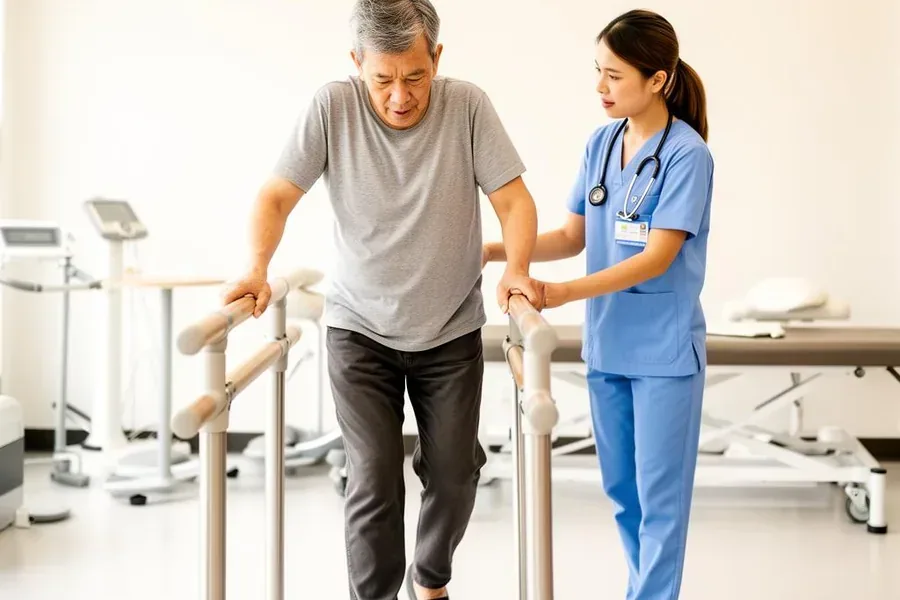
NICE guidance suggests people with stroke who can take part should be offered at least 3 hours of rehabilitation a day, at least 5 days a week, when they are able to manage it [1]. Ask each center how its timetable compares and who delivers each session.
At Sanpiti, therapy is usually scheduled 2–3 sessions per day according to tolerance. The exact program is set after assessment by a rehabilitation physician and physiotherapist.
24-hour nursing care and medical safety
Long-term rehabilitation care is not only therapy. Patients may need help with medicines, swallowing, skin care, toileting and blood pressure, day and night. Ask whether registered nurses are present on every shift and what happens if the patient becomes unwell at night.
A hospital-based program can make urgent tests and specialist review easier. A standalone residential center should explain its hospital transfer plan in writing.
Family accommodation for a three-month stay
Most international families want a relative close by. For three months, lodging can become a large part of the budget, so compare it as carefully as the patient’s care.
- Can a relative stay in the patient’s room, on the same campus or nearby?
- What is the monthly cost and what does it include (meals, laundry, transport)?
- Can the relative join therapy sessions for caregiver training?
- Are visiting hours flexible for families arriving from different time zones?
Cross-border care coordination
Before travel, the treating doctor should confirm the patient is fit to fly, and the receiving center should review medical records [2]. Send the discharge summary, latest scan reports and medicine list in advance.
During the stay, agree how often the family and the home doctor receive updates. At discharge, ask for an English summary, home exercise guidance, equipment advice and a contact person for questions after returning home.
Insurance: check with your insurer before travel. Sanpiti does not bill insurers directly; families pay Sanpiti and receive itemised invoices and medical reports to claim reimbursement, and approval depends on the policy.
How Sanpiti plans a three-month stay (publisher disclosure)
This guide is published by Sanpiti and is not an independent ranking. Sanpiti operates 9 branches and has served 5,000+ families over 10+ years. International patients are cared for at Jin Wellbeing, a hospital-based inpatient program in Bangkok with 24-hour nursing, English-speaking coordinators and English medical reports.
International-patient pricing at Jin Wellbeing starts from ฿65,900 per month for accommodation, meals and 24-hour nursing. Physiotherapy and procedures are charged separately according to the assessed program. Family stay arrangements are confirmed case by case. Outcomes vary and recovery cannot be guaranteed.
Jin Wellbeing hospital-based program
Frequently asked questions
How long is a typical international stroke rehabilitation stay?
Many families plan around 8–12 weeks, but the right length depends on the patient and is set after a physician assessment. At Sanpiti the average inpatient stay is about 2.6 months.
Is Thailand, Malaysia or Singapore better for stroke rehabilitation?
There is no single best country. Quality varies between centers in each country. Compare therapy minutes per day, 24-hour nursing, access to hospital care, family accommodation, care coordination and the total cost of the whole stay.
Can a family member stay with the patient for three months?
It depends on the center. Ask where a relative can stay, the monthly cost and whether they can join caregiver training. At Sanpiti, family stay is confirmed case by case.
How much does a three-month stay at Sanpiti cost?
International-patient pricing starts from ฿65,900 per month for accommodation, meals and 24-hour nursing. Physiotherapy and procedures are charged separately after assessment, so request an itemised written quote.
Does Sanpiti bill international insurance directly?
No. Families pay Sanpiti and receive itemised invoices and English medical reports to claim reimbursement from their insurer. Approval depends on the policy.