Thailand Stroke Rehab Options for International Families
Three care pathways, different goals: a practical guide to matching recovery, everyday support and comfort-focused care to your family’s needs before travelling.
Quick answer
For stroke rehabilitation in Thailand, compare care pathways by the patient’s medical stability, goals, ability to participate in therapy and daily assistance needs. Inpatient rehabilitation may suit patients who need coordinated post-stroke therapy and nursing while working towards functional goals. Home care may suit medically stable patients when the home, caregivers and visiting clinical services can safely meet their needs. Hospice is a comfort-focused pathway for people approaching the end of life, not a substitute for intensive rehabilitation. Palliative care can support symptom relief alongside rehabilitation and is not the same as hospice. A treating clinician should help decide the appropriate pathway and whether international travel is safe.
Compare the three care pathways
| Decision criterion | Inpatient rehabilitation | Home care | Hospice |
|---|---|---|---|
| Main goal | Improve function through coordinated rehabilitation, with nursing and medical review. | Support daily living at home; rehabilitation requires a separately arranged therapy plan. | Comfort, symptom control and family support near the end of life. |
| Who may be suitable | Stable patients with functional goals who need supervised therapy and substantial daily assistance. | Stable patients whose clinical needs can be met at home with reliable trained support. | Patients whose goals and clinical situation favour end-of-life care, after medical assessment. |
| Therapy and participation | Ask for disciplines, active treatment minutes, rest periods and progress reviews. | Ask which therapists visit, how often, and who supervises practice between visits. | Comfort-focused movement or positioning may help; intensive recovery is not the main purpose. |
| Nursing and bathroom help | Verify registered-nurse coverage, transfers, toileting, skin care and swallowing support. | Check caregiver competence, nurse visits, night cover and safe bathroom access. | Verify symptom-management cover, personal care and support for the family. |
| Medical escalation | Confirm the clinical lead, hospital access and emergency transfer arrangements. | Agree who to call, where urgent care is provided and how transport is arranged. | Agree the care plan for worsening symptoms, out-of-hours help and emergency preferences. |
| Travel and handover | Confirm admission acceptance, fitness to fly, escort needs and discharge documentation. | Confirm an accessible home, equipment and care staff before arrival. | Discuss whether travel adds burden and whether care nearer home better meets the patient’s wishes. |
| Cost comparison | Request separate accommodation, nursing, therapy, physician and procedure charges. | Include housing, caregiver shifts, nurse visits, therapy, equipment and transport. | Request the care scope, medicines, clinical visits and out-of-hours charges in writing. |
Start with the patient’s needs, not a facility label
International stroke recovery planning should begin with a recent medical summary and a realistic description of daily function. Can the patient sit safely, transfer to a wheelchair, use the bathroom, communicate needs and swallow safely? What help is needed at night? These answers matter more than a center’s marketing description.
A coordinated stroke rehabilitation team may include a rehabilitation physician, physiotherapists, occupational therapists, speech and language therapists, nurses and other professionals according to the person’s needs. Treatment should be tailored to goals and tolerance rather than a fixed timetable for everyone. [1]
New stroke symptoms, sudden deterioration or an unstable medical condition require urgent assessment, not an overseas rehabilitation booking. This guide is general information and cannot determine an individual patient’s care setting or travel readiness.
Pathway 1: Inpatient stroke rehabilitation in Thailand
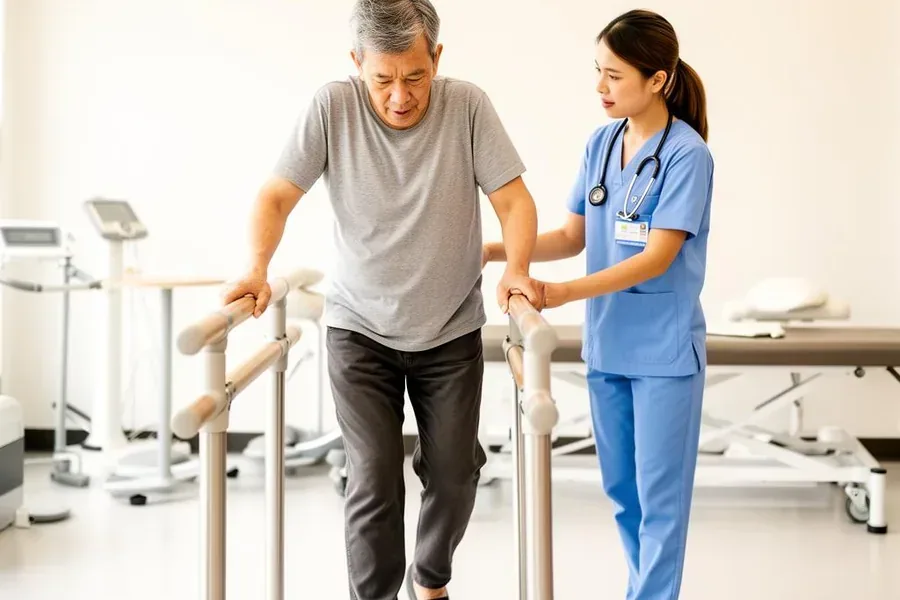
Inpatient rehabilitation combines a stay at a facility with a planned rehabilitation programme. It may be appropriate when a medically stable patient has recovery goals but needs coordinated therapy, nursing, medication support or assistance with transfers and daily living. Admission criteria differ; a patient does not have to be walking independently to be assessed.
Thailand rehabilitation centers are not all the same type of setting. Distinguish hospital-based inpatient rehabilitation from residential care with visiting therapists. Ask what the setting is licensed for, which medical needs it can manage and where an emergency would be treated.
Compare physiotherapy, occupational therapy, speech and swallowing support where indicated. Ask how walking practice, dressing, bathroom transfers and caregiver training fit into the plan. Recovery varies; an admission offer is not a guarantee of walking or independence. [1, 2]
- A named physician and a written, assessment-based treatment plan
- Registered-nurse coverage and help with toileting, transfers, feeding and skin care
- Session lengths, treatment disciplines, weekly scheduling and review dates
Pathway 2: Home care with a separate post-stroke therapy plan
Home care means support in a private home, whether in Thailand or in the patient’s home country. It may suit a medically stable person when the environment is accessible and trained caregivers, nursing and medical follow-up can safely meet their needs. A caregiver service alone is not equivalent to a multidisciplinary rehabilitation programme.
Before choosing home care, check bed-to-chair transfers, bathroom access, steps, suitable equipment, swallowing precautions and the availability of help at night. Arrange therapists and medical review separately when these are not part of the care service. Stroke recovery can continue outside hospital, but support and rehabilitation need to be planned. [1, 2]
For a short stay abroad, include accessible housing and local transport in the decision. A low hourly caregiver rate does not describe the full cost of continuous assistance, visiting nurses, post-stroke therapy and equipment. Ask who takes responsibility if a caregiver is absent or the patient becomes unwell.
- A home assessment, safe transfer plan and equipment ready before arrival
- Written duties and shift cover for caregivers versus registered nurses
- A therapy schedule, clinical follow-up and an emergency contact pathway
Pathway 3: Hospice and comfort-focused care
Hospice is generally a pathway for people approaching the end of life whose care goals focus on comfort and support. A severe stroke, inability to walk or slow rehabilitation progress does not by itself establish that hospice is appropriate. The patient’s condition, prognosis, preferences and goals require a discussion with the treating team; eligibility and services differ by provider.
Palliative care is broader: it aims to reduce suffering associated with serious illness and can begin earlier alongside other treatment, including rehabilitation when appropriate. It is not limited to the final days of life. Hospice and palliative care should therefore not be treated as interchangeable labels. [3]
Comfort-focused care may include pain and symptom management, positioning, gentle movement, mouth and skin care, emotional support and help for caregivers. Ask about out-of-hours clinical support and the agreed approach to hospital transfer if symptoms worsen.
For overseas families, travelling may add fatigue and disruption. Discuss whether care close to home would better respect the patient’s wishes and support the family. This article compares pathways; it does not establish hospice eligibility or promise that a particular Thai provider accepts international hospice admissions.
How to shortlist the right pathway
Ask the treating clinician to identify the current priority: functional rehabilitation, safe long-term daily support, comfort-focused care, or a combination. The pathway may change over time. A patient can move from inpatient rehabilitation to home care, and palliative support can be added without automatically ending rehabilitation.
Send the same case summary to each potential provider so the comparison is meaningful. Include the stroke date and type, medicines, recent complications, feeding needs, mobility, communication, assistance required and family goals. Ask each provider to explain why its service is suitable and which needs fall outside its scope.
- Define two or three daily-life goals and the support required to work on them
- Confirm the proposed setting, staffing and escalation plan in writing
- Compare an itemised quotation for the same duration and care needs
- Agree a review date and what would trigger a change of pathway
Medical travel to Thailand: decide readiness before booking
Cross-border healthcare requires coordination between the home-country clinician, the receiving team, the family and sometimes the airline or an insurer. A treating clinician should assess travel readiness; an airline may require its own medical form or approval. Do not rely on a universal waiting period after stroke.
Before paying for flights, confirm admission acceptance, assistance through the airport, an appropriate escort, medicines, accessible transport and any oxygen or equipment requirements. Check visa and entry requirements with official authorities for the traveller’s nationality and planned stay. Do not assume insurance covers elective overseas rehabilitation or medical evacuation.
CDC advises medical travellers to research providers, obtain treatment and cost information and plan follow-up. Collect medical records and agree who will continue care after returning home. [4]
Compare total care costs, not a headline starting rate
Ask for a written breakdown covering accommodation, meals, caregiver or nursing cover, physician review, each therapy discipline, medicines, equipment, procedures and transport. Clarify deposits, cancellation terms, extra-care charges and what happens if the stay needs to be extended.
At Sanpiti’s hospital-based Jin Wellbeing programme, international-patient pricing starts from ฿65,900 per month for accommodation, meals and 24-hour nursing. Physiotherapy and procedures are charged separately according to the assessed programme. This is a starting rate, not an all-inclusive treatment price. The family receives a treatment plan and written quotation after assessment by a rehabilitation physician and physiotherapist.
Plan the next setting before the first admission
Discharge planning should cover more than the flight home. Request an English clinical and functional summary, a current medication list, equipment recommendations, a caregiver training record and a follow-up plan that the receiving team can use.
If the patient will move to home care, ensure the home and support team can manage transfers, toileting and feeding safely. If goals or medical needs change, ask for a fresh assessment rather than continuing the same programme automatically. Agree who to contact for deterioration or questions after discharge. [1, 4]
Where Sanpiti fits in this comparison
This guide is published by Sanpiti, not an independent ranking. Sanpiti’s international-patient offer at Jin Wellbeing is hospital-based inpatient rehabilitation with 24-hour nursing, English-speaking coordinators and English medical reports. The team assesses suitability, therapy tolerance and daily assistance needs before proposing a plan.
Sanpiti’s inpatient programme should not be confused with a home caregiver service or hospice solely because a patient needs help with daily living. Ask the team to confirm that the programme can meet the individual patient’s needs. This comparison does not claim that Sanpiti provides each of the three pathways described.
Frequently asked questions
Which stroke rehabilitation option in Thailand is right for an international patient?
The choice depends on medical stability, rehabilitation goals, therapy tolerance, daily assistance needs and the available support. Ask the treating clinician and receiving team to compare inpatient rehabilitation, safe home care and comfort-focused care against the patient’s actual needs.
Is home care the same as inpatient stroke rehabilitation?
No. Home care supports daily living in a private home. A coordinated rehabilitation programme requires appropriate therapists, clinical review and goal-based treatment; these may need to be arranged separately. Inpatient care may combine those services with accommodation and nursing.
Does a severe stroke or inability to walk mean hospice is needed?
No. Disability alone does not determine hospice suitability. Hospice focuses on end-of-life comfort; a treating clinician should discuss prognosis, preferences and goals. Many patients with significant disability may still have rehabilitation goals.
Can palliative care be provided alongside post-stroke therapy?
Yes, when clinically appropriate. Palliative care addresses symptoms and quality of life in serious illness and can accompany rehabilitation. It is broader than hospice and is not limited to the final days of life.
What should overseas families check before medical travel to Thailand?
Confirm clinical fitness for travel, admission acceptance, airline requirements, escort and equipment needs, accessible transport, insurance, visa requirements and follow-up at home. The treating clinician and receiving team should coordinate a case-specific plan before flights are booked.
What is the starting cost for international patients at Sanpiti?
Jin Wellbeing international-patient pricing starts from ฿65,900 per month for accommodation, meals and 24-hour nursing. Physiotherapy and procedures are charged separately according to the assessed programme. It is not an all-inclusive treatment price; request a written quotation after assessment.