
Quick Answer
Arm weakness after stroke (upper-limb hemiparesis) is caused by damage to the motor pathways, not the arm itself. About 80% of survivors have it acutely and 40-50% still have limited arm use at 6 months (Kwakkel, Stroke 2003). The strongest predictor is whether any finger or shoulder movement returns within 4 weeks. High-repetition, task-specific training — at least 2-3 sessions a day during the first 3-6 months — is the only intervention with consistent Level-1 evidence.
1. What the symptom actually feels like
Families describe it in very consistent ways: the arm feels "heavy like a sandbag", it slips off the lap, the hand will not open, or the shoulder aches when the patient sits up. Some patients can shrug the shoulder but cannot bend the elbow; others can move the arm but cannot grade the force. All of these are hemiparesis — partial weakness — not a torn muscle or a trapped nerve.
- Heaviness or "dead weight" sensation on one side only
- Shoulder movement returns before elbow, elbow before wrist, wrist before fingers
- The hand closes into a fist and is hard to open (early spasticity)
- Aching or pulling pain in the shoulder, especially when sitting or being lifted
2. Why it happens
A stroke injures the corticospinal tract — the wiring that carries movement commands from the brain to the spinal cord. The muscle is healthy; the signal is not arriving. Because the pathway can be rewired through repetition (neuroplasticity), the arm is trainable, but the brain needs thousands of correct repetitions, not dozens.
3. Realistic recovery timeline
Proportional recovery research (Prabhakaran, Neurorehabil Neural Repair 2008) shows most patients recover roughly 70% of their maximum possible arm improvement within 3 months — if therapy dose is adequate.
- Week 1-2: flaccid or minimal movement; focus on positioning and preventing shoulder subluxation
- Week 2-12: the highest-yield window; shoulder and elbow movement usually return first
- Month 3-6: hand and finger control, grip strength, and fine motor tasks
- Beyond 6 months: gains continue but require high-intensity blocks (ICARE, JAMA 2016)
4. Red flags to raise with the medical team today
These are common, treatable, and frequently missed at home.
- A visible gap under the shoulder joint — shoulder subluxation; the arm needs support, never pulling
- Increasing stiffness or a clenched fist — developing spasticity, treatable early
- Swelling of the hand with pain on movement — complex regional pain syndrome
- Sudden loss of movement that was previously present — needs urgent medical review
5. What treatment actually works
Evidence-supported components of an upper-limb programme:
- Task-specific repetitive training — reaching, grasping, releasing real objects, 300+ reps per session
- Constraint-Induced Movement Therapy for patients with some wrist and finger extension (EXCITE, JAMA 2006)
- Mirror therapy and mental practice for severe weakness with no active movement
- Electrical stimulation (FES) to re-activate wrist and finger extensors
- rTMS priming before motor training to increase cortical excitability (Hsu, Stroke 2012)
6. How Sanpiti handles a weak arm
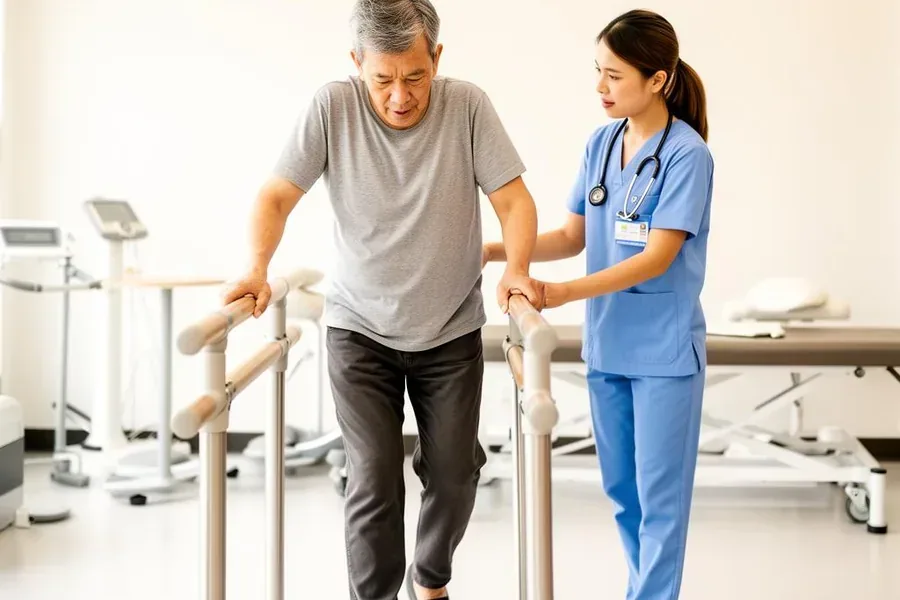
Sanpiti is a stroke-only, hospital-based inpatient rehabilitation service. Patients receive 2-3 therapy sessions per day, with a PM&R physician and physiotherapist jointly reassessing every 2 weeks and adjusting dose and technology (TMS / PMS / ESWT) to the recovery phase. Average inpatient stay is 2.6 months, covering the highest-yield recovery window in full.
Frequently Asked Questions
Will my arm ever move again after a stroke?
If any voluntary shoulder or finger movement returns within the first 4 weeks, the likelihood of useful arm function is high. If the arm is completely flaccid at 4 weeks, meaningful gains are still possible but usually slower and require intensive therapy with mirror therapy, electrical stimulation, and rTMS priming.
Why does my arm feel heavy but not painful?
Heaviness is the sensation of weak muscle activation plus loss of postural control at the shoulder. Pain usually appears later, from shoulder subluxation or spasticity, which is why early positioning and support matter.
Should I massage or stretch the weak arm at home?
Gentle range-of-motion within a pain-free range, taught by a physiotherapist, is helpful. Never pull the arm to lift or reposition the patient — that is the most common cause of shoulder injury after stroke.
How many hours of therapy does the arm need?
Dose-response studies show meaningful arm gains generally require several hundred repetitions per session and at least 2-3 sessions per day during the subacute phase. Once-a-week outpatient therapy is rarely enough in the first 3 months.
Get an upper-limb assessment
Sanpiti's PM&R physician and stroke-specialist physiotherapists assess arm recovery potential and build a daily intensive plan.