
Quick Answer
Hand recovery responds to high-repetition, task-specific training. Five evidence-based approaches dominate: CIMT, mirror therapy, mental practice, robotic-assisted training, and bilateral arm training. Sanpiti layers all five within intensive 2–3 daily OT/PT sessions.
Why Hand Recovery Is Hard — and Hopeful
The hand has the largest cortical representation of any body part. Damage to the corticospinal tract often produces persistent weakness, but the same vast cortical map also means there is enormous potential for plastic reorganization with the right training.
Five Evidence-Based Techniques
Modern upper-limb rehabilitation combines:
- Constraint-Induced Movement Therapy (CIMT) — restrains the unaffected hand to force use of the affected hand for 6 hours/day, 2 weeks
- Mirror therapy — visual illusion that the affected hand is moving, driving cortical activation
- Mental practice / motor imagery — rehearsing movements mentally
- Robotic-assisted training (e.g., InMotion, Armeo) — high-dose repetition with feedback
- Bilateral arm training — both hands move together to recruit weak side
Realistic Hand Recovery Timeline
Patients with some initial wrist/finger movement within 4 weeks have the best prognosis for functional hand use. Even severely affected patients can regain useful gross grasp and assistive use of the hand with 12+ weeks of intensive training.
How Sanpiti Trains the Hand
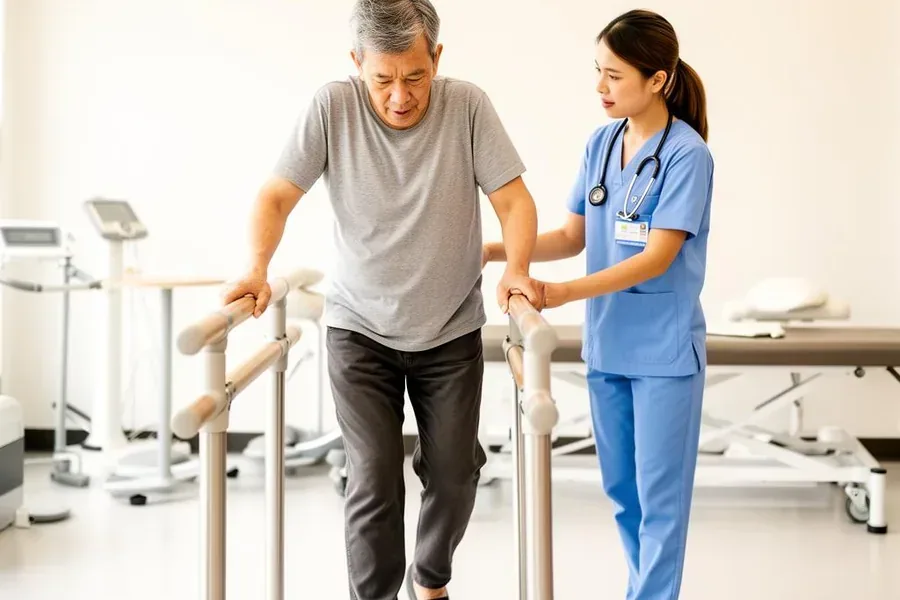
Occupational therapy at Sanpiti focuses on real tasks: spoon use, button fastening, cup handling. CIMT is applied to suitable candidates; mirror therapy and FES support patients with minimal initial movement; robotic devices handle high-repetition dose.
Frequently Asked Questions
Can hand function fully return after stroke?
Full pre-stroke function is possible for milder strokes. For moderate-to-severe arm paresis, most patients regain meaningful assistive use with intensive training; about 30–40% regain near-normal function.
What is CIMT?
Constraint-Induced Movement Therapy: the unaffected hand is restrained in a mitt for 6+ hours per day while the patient uses only the affected hand for daily tasks, over a 2-week intensive block.
Does mirror therapy actually work?
Yes. Multiple Cochrane reviews show mirror therapy improves motor function, ADLs, and visuospatial neglect after stroke, especially in patients with severe upper-limb paresis.
How many hours of hand therapy per day?
Evidence supports 60–90 minutes/day of focused upper-limb training. Sanpiti delivers OT sessions twice daily within its 2–3 session/day inpatient model.
Regain Hand Use With Intensive OT
Sanpiti combines CIMT, mirror therapy, FES, and robotic-assisted training in twice-daily occupational therapy sessions.