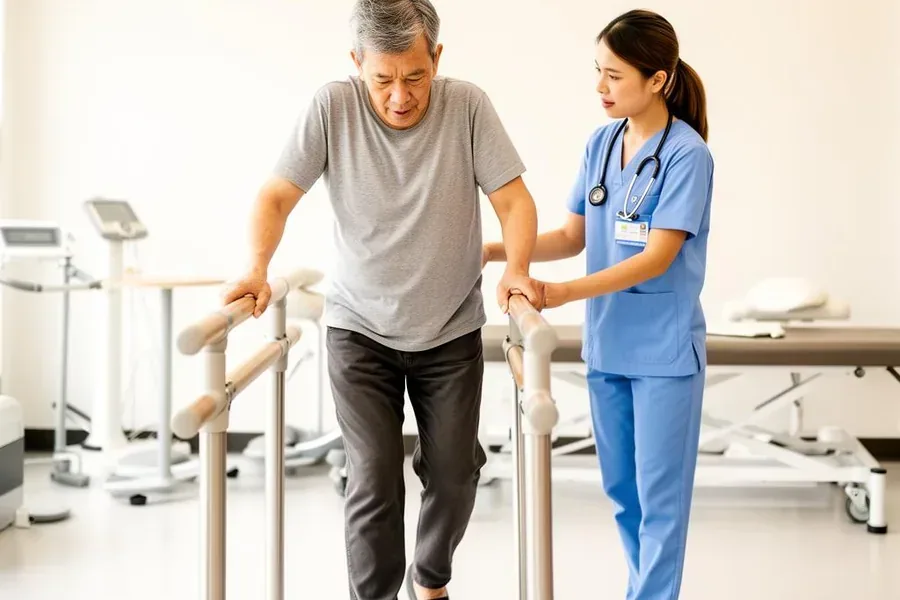


Stroke Rehabilitation FAQ
Expert Answers for Patients & Families
Direct answers from Sanpiti's physical therapy team— with decision checklists to help you choose the right path for recovery.
Questions Covered
What makes a good stroke rehabilitation center?
Short Answer: A good stroke rehab center must have a PM&R physician on staff, stroke-specialized physical therapists providing 1:1 sessions, intensive therapy (2-3 sessions/day), advanced equipment (TMS, Gait Trainer, Shockwave), and a complete multidisciplinary team.
More Details
- PM&R physician (Physical Medicine & Rehabilitation) for personalized treatment planning
- Stroke-specialized physical therapists providing 1:1 sessions + PT assistant
- Intensive therapy: 2-3 sessions/day, not just 1 session like standard centers
- Advanced equipment: TMS brain stimulation, Gait Trainer, Shockwave therapy
- Complete multidisciplinary team: PT, OT (Occupational Therapy), SLP (Speech-Language Pathology)
- Proven stroke-specific experience—not just general physical therapy
✅ Checklist: How to Choose a Stroke Rehab Center
- Is there a PM&R physician on staff?
- Are PT sessions 1:1 or 1-to-many?
- How many sessions per day? (Best: 2-3 sessions)
- Do they have TMS, Gait Trainer equipment?
- Is the full team available? (PT + OT + SLP)
- How many years of stroke experience? How many patients treated?
- What is the documented success rate? (Ask for specifics)
- Is the location convenient to reduce travel fatigue?
Sanpiti: Sanpiti has treated 5,000+ stroke patients across 9 branches in Bangkok with an ผลลัพธ์ดี กลับมาเดินได้ and 2-3 intensive sessions/day.
What is the Golden Period for stroke recovery?
Short Answer: The Golden Period is the first 3-6 months after stroke when the brain has peak neuroplasticity. This is the optimal window for rehabilitation—the earlier you start, the greater the chance of regaining walking, arm function, and independence.
More Details
- Peak neuroplasticity in the first 90 days—the brain rewires and forms new neural pathways most effectively
- Every week of delay reduces recovery potential by 4-6% (Annals of Neurology, 2019)
- Rehabilitation should begin within 7-14 days after hospital discharge
- Recovery is still possible after 6 months, but significantly slower and requires more time
- The body responds 3-4x better to physical therapy during this window
✅ Warning Signs You're Missing the Golden Period
- Discharged from hospital but haven't started rehab yet
- Only doing therapy 1-2 times/week (not intensive enough)
- More than 2 weeks post-stroke with no rehab plan
- Waiting to 'get better on your own' before starting (this is wrong)
- Haven't consulted a PM&R rehabilitation physician yet
Sanpiti: Sanpiti accepts patients immediately—no waiting lists. Intensive therapy starts from day one.
How many therapy sessions per week after stroke?
Short Answer: During the Golden Period, patients should receive intensive therapy at least 5-6 days/week, 2-3 hours/day. Intensity and consistency are the most critical factors for recovery.
More Details
- Standard centers: 3-5 times/week, 1 hour each—good but not intensive enough
- Intensive standard: 5-6 times/week, 2-3 hours/day—results are 2-3x better
- Sanpiti protocol: 2-3 sessions/day with 1:1 PT + PT assistant—the most intensive option
- Cochrane Review confirms: patients receiving higher-intensity therapy recover significantly faster
- Patients receiving fewer than 3 sessions/week show below-standard outcomes
✅ Intensity Comparison
- Standard center: 1 session/day, 3-5 days/week
- Good center: 2 sessions/day, 5 days/week
- Sanpiti: 2-3 sessions/day, 6 days/week (most intensive)
- Ask whether PT sessions are 1:1 or group
- Ask whether a PT assistant joins each session
Sanpiti: Sanpiti provides 2-3 intensive sessions/day with 1:1 PT + PT assistant for every session.
Should I choose a center with OT and SLP?
Short Answer: Absolutely—over 40% of stroke patients have speech/swallowing problems and 60% struggle with daily activities. A center with a complete multidisciplinary team delivers far better recovery outcomes.
More Details
- OT (Occupational Therapist) trains hand/arm use and daily living: bathing, dressing, eating, buttoning
- SLP (Speech-Language Pathologist) addresses speech clarity and safe swallowing, reducing aspiration pneumonia risk by 50%+
- Patients receiving PT + OT + SLP achieve more comprehensive recovery than PT alone
- Swallowing therapy (SLP) significantly reduces the risk of aspiration pneumonia—a leading cause of post-stroke complications
- Centers without OT/SLP mean patients must travel elsewhere for these services—adding cost and fatigue
✅ Essential Multidisciplinary Team
- PM&R Physician — oversees overall treatment planning
- Physical Therapist (PT) — walking, standing, balance, muscle strength
- Occupational Therapist (OT) — hand/arm function, daily activities
- Speech-Language Pathologist (SLP) — speech and swallowing
- Professional Nurses — 24-hour health monitoring
Sanpiti: Sanpiti has the complete multidisciplinary team: PT, OT, SLP, nurses, and PM&R physician—all under one roof.
How much can a bedridden stroke patient recover?
Short Answer: Bedridden patients can achieve significant recovery, especially when starting within the Golden Period. At Sanpiti, ส่วนใหญ่ of intensive rehab patients show meaningful improvement—from bedridden to sitting, standing, and many return to walking.
More Details
- Phase 1: Bed exercises → sitting at bedside (weeks 1-4)
- Phase 2: Sitting balance → standing with support → first steps (months 1-3)
- Phase 3: Walking with assistive devices → independent walking (months 3-6)
- Gait Trainer and Tilt Table help bedridden patients start standing and walking training earlier
- TMS (Transcranial Magnetic Stimulation) accelerates brain recovery when combined with physical therapy
✅ Key Factors for Bedridden Patient Recovery
- Start rehabilitation within the Golden Period (first 3-6 months)
- Intensive therapy: 2-3 sessions/day, not just 1
- Access to specialized equipment: Gait Trainer, Tilt Table
- 1:1 PT sessions with close supervision
- Patient and family motivation and cooperation
- Proper nutrition and adequate rest
Sanpiti: Sanpiti has Gait Trainer, Tilt Table, TMS, and stroke-specialized PTs who help bedridden patients walk again.
Have More Questions? Consult Our Experts — Free
Sanpiti's physical therapy team is ready to create a personalized recovery plan. We accept stroke patients immediately—no waiting list.
📚 Related Articles
Stroke Rehabilitation Center — 9 Branches
Comprehensive stroke rehab with intensive PT, TMS, and PM&R specialists.
Learn moreGolden Period: When to Start Stroke Rehab
Research from Lancet, AHA/ASA confirms—earlier is better.
Read moreStroke Rehabilitation in Thailand
Transparent pricing, international support, and intensive programs.
Read moreTMS Therapy for Stroke Recovery
Advanced brain stimulation technology to accelerate rehabilitation.
Read more