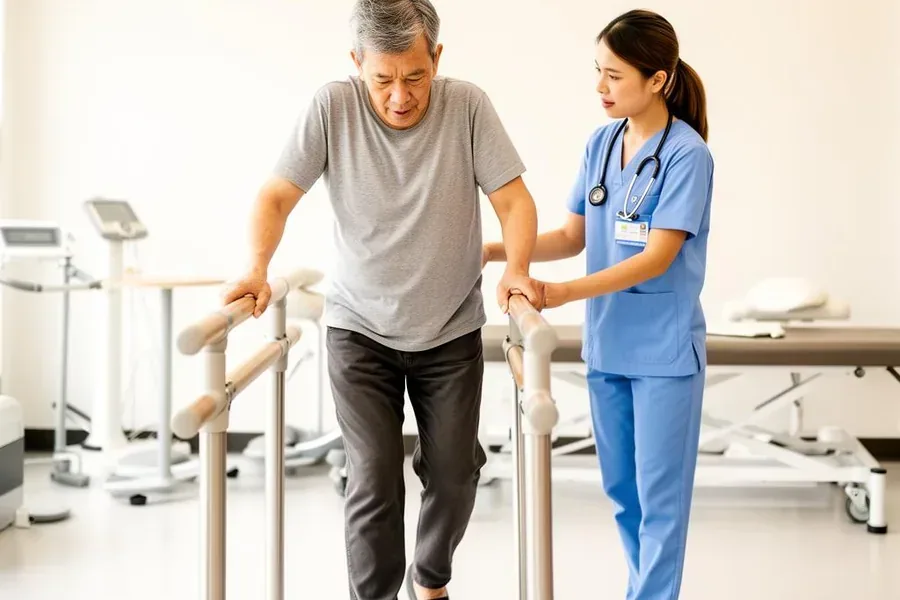

Why Sanpiti Is Hospital-Based, Not a Nursing Home
Understanding the critical difference between hospital-grade neurological rehabilitation and custodial nursing home care — and why it matters for stroke recovery.
Published March 27, 2026 · By PT Kultinee Glinpoon (กภ.9032) · 8 min read
Quick Answer: Is Sanpiti a Nursing Home?
No. Sanpiti Rehabilitation Center is a hospital-based medical rehabilitation center with 9 branches across Bangkok. Our flagship facility at Jin Wellbeing County operates within a hospital campus featuring:
- Zero-Minute Transfer to Hospital Emergency Room
- PM&R Specialists (Physiatrists) & Neurologists on-site
- 2-3 intensive therapy sessions per day with 1:1 therapist ratio
- TMS Brain Stimulation (FDA-approved neuroplasticity therapy)
- Integrated Dialysis Center on campus
- 24-hour medical-grade inpatient care
Last Updated: March 2026 · Based on 5,000+ families served over 10+ years
The Dangerous Misconception
Many families searching for post-stroke care in Bangkok confuse rehabilitation centers with nursing homes. This misconception can cost patients their most critical recovery window — the Golden Period (first 3-6 months post-stroke) when the brain has peak neuroplasticity.
Choosing a nursing home during the Golden Period means choosing comfort over recovery. While nursing homes provide essential custodial care, they are not designed for the intensive, physician-led rehabilitation that stroke patients need to regain independence.
Sanpiti was purpose-built as a neurological rehabilitation institute — every aspect of our facility, staffing, and protocols is designed for functional recovery, not long-term residential care.
Hospital-Based Rehab vs. Nursing Home: Side-by-Side
The differences are not subtle — they fundamentally determine recovery outcomes.
5 Pillars That Make Sanpiti Hospital-Grade
These capabilities define the gap between medical rehabilitation and custodial care.
1. Zero-Minute Hospital ER Transfer
Our flagship at Jin Wellbeing County is physically connected to the hospital. When emergencies occur — recurrent stroke, cardiac events, seizures — patients are transferred to the ER instantly. No ambulance wait. No traffic delays. This saves lives that nursing homes simply cannot protect.
2. Physician-Led Medical Team
Every patient's rehabilitation program is designed and supervised by PM&R Specialists (Physiatrists) and Neurologists — not just caregivers. Our founder PT Kultinee Glinpoon (License กภ.9032, Mahidol University) and co-founder Dr. Korawlai Glinpoon (License ว.53552) ensure medical-grade standards across all 9 branches through the Sanpiti Academy training system.
3. Intensive Therapy Protocol (2-3 Sessions/Day)
Stroke recovery requires intensive, repetitive practice to rewire neural pathways. Sanpiti delivers 2-3 therapy sessions per day with a 1:1 therapist-to-patient ratio — the gold standard for neuroplasticity-based recovery. Nursing homes typically offer 0-1 sessions per week, which is insufficient for meaningful neurological recovery.
4. Advanced Medical Technology
Our facilities include TMS Brain Stimulation (FDA-approved transcranial magnetic stimulation), Robotic Gait Training, Hydrotherapy, PMS (Peripheral Magnetic Stimulation), and Shockwave Therapy. These are hospital-grade technologies that require physician supervision — they are not found in nursing homes.
5. 24-Hour Medical-Grade Inpatient Care
Our inpatient program provides round-the-clock medical monitoring with trained nursing staff, vital sign tracking, medication management, and immediate intervention capabilities. This is fundamentally different from nursing home overnight care, which focuses on residential comfort rather than medical outcomes.
Jin Wellbeing County: Our Hospital-Based Flagship
Jin Wellbeing County in Rangsit represents the pinnacle of Sanpiti's hospital-based model. This flagship facility is physically integrated into a hospital campus, providing a level of medical safety and capability that standalone facilities cannot match:
When to Choose Hospital-Based Rehab vs. Nursing Home
Choose Hospital-Based Rehab When:
- Within the Golden Period (0-6 months post-stroke)
- Patient has recovery potential and rehabilitation goals
- Complex medical needs (dialysis, cardiac monitoring)
- Need for intensive daily therapy (2-3 sessions/day)
- Risk of recurrent stroke or medical emergencies
- Specific functional goals (walking, speaking, swallowing)
Nursing Home May Be Appropriate When:
- Rehabilitation goals have been achieved
- Patient needs long-term residential care
- Focus is on comfort and daily living assistance
- Medically stable with no acute rehabilitation needs
- Family cannot provide home care
- Maintenance-phase therapy is sufficient
Frequently Asked Questions
Common questions about Sanpiti's hospital-based rehabilitation model.
Choose Hospital-Grade Recovery
Don't let the Golden Period pass with custodial care. Speak with our medical team about intensive, hospital-based rehabilitation — free consultation, no obligation.