
How TMS works on the brain after stroke
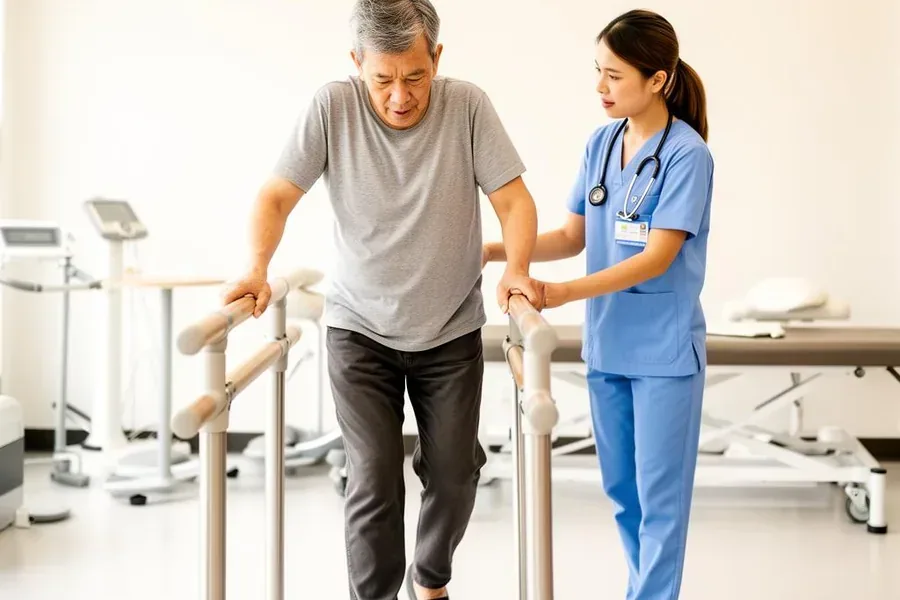
Transcranial magnetic stimulation sends magnetic pulses through the skull to modulate neurons in the motor cortex, without surgery and without drugs. After a stroke the two hemispheres lose their balance; rTMS is used to restore that balance and place the brain in a temporary state where it is primed to learn. What happens in the next hour — the therapy that follows — is what turns that window into function.
1. Prime the brain
TMS opens the learning window in the motor cortex.
2. Wake the periphery
PMS activates peripheral nerves and weakened muscles.
3. Train immediately
Physiotherapy and OT within the same session block.
This page is general medical education, not a guarantee of outcome. Results differ between patients. TMS must be prescribed by a physician after contraindication screening.
Where TMS for stroke is available in Thailand
Providers fall into three groups — university and public hospitals (long waiting lists, capped session counts), private hospital rehabilitation departments (single outpatient sessions), and specialist inpatient stroke rehabilitation centres (continuous courses with therapy immediately afterwards). The locations below are Sanpiti sites running TMS-based neuro-rehabilitation programmes.
Sanpiti Nawamin (flagship)
Bueng Kum, Bangkok
Inpatient, 24 hours
Serves: Nawamin, Khlong Kum, Ram Inthra, Bang Kapi
Sanpiti Nuanchan
Bueng Kum, Bangkok
Inpatient, 24 hours
Serves: Nuanchan, Khlong Kum, Nawamin
Sanpiti Nawamin 143
Bueng Kum, Bangkok
Mon–Fri 08:00–17:00
Serves: Nawamin, Nuanchan, Bueng Kum
Sanpiti Ratchada
Huai Khwang, Bangkok
Mon–Fri 08:00–17:00
Serves: Ratchada, Din Daeng, Sutthisan, Lat Phrao (near MRT)
Sanpiti Bang Yai
Bang Yai, Nonthaburi
Mon–Fri 08:00–17:00
Serves: Bang Yai, Bang Kruai, Sai Noi, Bang Bua Thong
Sanpiti Pluempiti Nonthaburi
Bang Yai, Nonthaburi
Mon–Fri 08:00–17:00
Serves: Bang Yai, Bang Len, Bang Kruai
Sanpiti Lam Luk Ka
Lam Luk Ka, Pathum Thani
Inpatient, 24 hours
Serves: Lam Luk Ka, Lat Sawai, Rangsit, Thanyaburi
Sanpiti Jin Wellbeing, Rangsit
Rangsit, Pathum Thani
Inpatient, 24 hours — hospital-integrated, AACI-accredited
Serves: Rangsit, Thanyaburi, Khlong Luang, Ayutthaya (20 min from DMK airport)
Sanpiti Sena
Sena, Ayutthaya
Inpatient, 24 hours
Serves: Sena, Ayutthaya, Ang Thong, Sing Buri
International patients are admitted at the Jin Wellbeing Rangsit campus, from ฿65,900 per month inclusive of accommodation, meals, 24-hour nursing and daily therapy. See the medical tourism guide for 30/60/90-day programmes.
How to choose where to have TMS
- A rehabilitation physician screens contraindications and sets the session count individually.
- Physiotherapy and occupational therapy follow immediately, in the same building.
- The course runs continuously — no multi-week gaps caused by waiting lists.
- Progress is measured numerically, e.g. Barthel Index every 2–4 weeks.
- 24-hour nursing is available for patients with feeding tubes or tracheostomy.
External references
Every clinical statement above is traceable to a published guideline or peer-reviewed review. Each entry links to a resolvable DOI or official source so it can be verified independently.
[1] Lefaucheur JP, Aleman A, Baeken C, et al. (2020). Evidence-based guidelines on the therapeutic use of repetitive transcranial magnetic stimulation (rTMS): An update (2014–2018)
Clinical Neurophysiology 131(2):474–528
International evidence-based guideline grading rTMS protocols for post-stroke motor deficit; site and frequency must be matched to the lesion.
[2] Rossi S, Antal A, Bestmann S, et al. (2021). Safety and recommendations for TMS use in healthy subjects and patient populations, with updates on training, ethical and regulatory issues
Clinical Neurophysiology 132(1):269–306
International safety standard requiring contraindication screening (intracranial metal, cardiac devices, seizure history) before every TMS session.
[3] Hao Z, Wang D, Zeng Y, Liu M. (2013). Repetitive transcranial magnetic stimulation for improving function after stroke
Cochrane Database of Systematic Reviews, Issue 5. Art. No.: CD008862
Cochrane systematic review: rTMS alone is insufficient — it must accompany active rehabilitation training, and evidence quality still varies.
[4] Winstein CJ, Stein J, Arena R, et al. (American Heart Association/American Stroke Association) (2016). Guidelines for Adult Stroke Rehabilitation and Recovery: A Guideline for Healthcare Professionals
Stroke 47(6):e98–e169
AHA/ASA guideline recommends organised, high-intensity interdisciplinary inpatient rehabilitation over fragmented outpatient sessions.
[5] Fisicaro F, Lanza G, Grasso AA, et al. (2019). Repetitive transcranial magnetic stimulation in stroke rehabilitation: review of the current evidence and pitfalls
Therapeutic Advances in Neurological Disorders 12:1756286419878317
Review of rTMS evidence and pitfalls: outcomes depend on stroke stage, lesion site, and the training delivered immediately afterwards.
[6] World Health Organization (2024). Rehabilitation — World Health Organization fact sheet
WHO Newsroom Fact Sheets
WHO positions rehabilitation as an essential health service that should start early and be delivered continuously, not as an optional add-on.
Reviewed by the rehabilitation medicine team at Sanpiti Rehabilitation Center. To cite this page, use https://www.sanpiti.com/en/articles/tms-stroke-rehab-where/
Frequently asked questions about TMS
Ask whether TMS is right for your patient
Send a short history, CT/MRI results and the current medication list. Our rehabilitation physicians and physiotherapists will assess suitability and design a TMS-plus-intensive-therapy plan at no charge.