

Quick Answer
Neuroplasticity is the brain's ability to form new connections between neurons. After stroke, dead cells don't come back — but surrounding cells can learn to take over via cortical remapping. This is why intensive rehabilitation (100–1,000 repetitions/day per task) is essential. The mechanism works lifelong, but requires intensity and task-specificity.
1. The Brain Doesn't All Die — Some Cells Can Still Learn
After stroke, cells in the core die within minutes, but surrounding tissue — the penumbra and perilesional area — remains alive and trainable. Nudo et al. (Science 1996) showed motor cortex in monkeys expanded control area by 40% after repetitive limb training.
2. Kleim & Jones — The 10 Principles Every Rehab Clinic Follows
The 2008 paper by Kleim & Jones is the neurorehabilitation Bible worldwide:
- Use It or Lose It — unused brain areas degrade
- Use It and Improve It — repeated use strengthens
- Specificity — train the exact task you want to recover
- Repetition Matters — 100-1,000 reps/day per task
- Intensity Matters — higher dose, better outcomes
- Time Matters — earlier is better, but never too late
- Salience Matters — meaningful tasks recover better
- Age Matters — younger recovers faster, but adults still recover
- Transference — training one task can help another
- Interference — compensation habits can block recovery
3. Three Mechanisms of Brain Self-Repair
Occurring simultaneously during the Golden Period and continuing (more slowly) after 6 months:
- Synaptic plasticity — neurons form stronger connections (LTP/LTD)
- Structural plasticity — new dendritic spines and axonal sprouting
- Functional reorganization — cortical remapping to compensate
4. Technologies That Accelerate Neuroplasticity
Evidence-based adjuncts proven to enhance rehab outcomes:
- rTMS — Hsu et al. (Stroke 2012) meta-analysis: significant motor recovery gains
- Peripheral Magnetic Stimulation (PMS)
- Functional Electrical Stimulation (FES)
- Constraint-Induced Movement Therapy (CIMT)
- Mirror Therapy
- Robotic training (Lokomat, ArmeoSpring)
5. Sanpiti's Neuroplasticity-Based Program
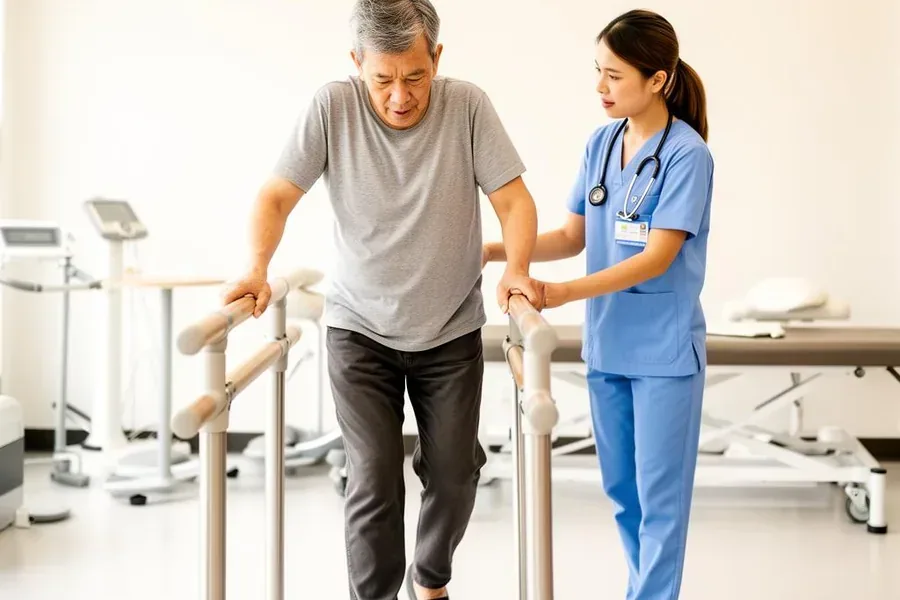
Every branch is designed around Kleim & Jones principles — PT/OT/SLP 2-3 sessions/day (high intensity) + task-specific training + TMS/PMS + FES. Average stay 2.6 months, 87% walking before discharge (n=5,000+ families over 10+ years).
Frequently Asked Questions
Does neuroplasticity have an expiration date?
No. Ward et al. (Brain 2019) proved chronic stroke patients (average 30 months post-stroke) still recover with intensive training. Higher dose and longer duration are required later.
Can I do neuroplasticity training at home?
Partially — but intensity is usually insufficient. Lohse (Stroke 2014) recommends 17 hours/week, which is hard to sustain at home. Inpatient rehab provides higher dose plus adjunctive technology like TMS.
Why does repetition matter so much?
The brain learns through Long-Term Potentiation — synapses stimulated repeatedly become stronger. Butefisch et al. (1995) confirmed 100-1,000 reps/day per task outperforms low-repetition training.
Is neuroplasticity different in children vs elderly?
Speed differs — children recover faster, but older adults still recover. Age is Kleim & Jones principle #8, but not a barrier.
Rehabilitation Built on Neuroplasticity Principles
Every Sanpiti program follows Kleim & Jones' 10 principles — intensive, task-specific, and repetition-driven.