
Quick Answer
Yes — chronic stroke patients can still recover. The EXCITE Trial (Wolf, JAMA 2006) showed CIMT in patients 3–9 months post-stroke improved arm use in 76%. Ward et al. (Brain 2019) demonstrated 10.7-point Fugl-Meyer gains in patients averaging 30 months post-stroke with 90 hours of intensive training. Neuroplasticity does not expire — it just requires more intensity later.
1. Why the "6-Month Cutoff" Myth Persists
Historically, physicians believed recovery plateaued at 3–6 months because spontaneous recovery is fastest then. Modern MRI studies show neuroplasticity continues indefinitely — it simply slows. Ballester et al. (Neurorehabil Neural Repair 2019) found 10% of recovery occurs after 6 months even without special intervention, and much more with intensive training.
2. Landmark Evidence for Late Recovery
Key RCTs supporting chronic stroke rehabilitation:
- EXCITE Trial (Wolf, JAMA 2006, n=222) — CIMT 3-9 months post-stroke → 76% improved arm use, sustained 2 years
- Ward et al. (Brain 2019, n=224) — 90 hours intensive training in patients averaging 30 months post-stroke → Fugl-Meyer +10.7
- Page et al. (Stroke 2004) — mCIMT 1-6 months = same benefit as 6-12 months
- Krakauer et al. (2012) meta-analysis — dose-response still works after 12 months
3. Why Late Recovery Works — The Neuroplasticity Mechanism
Surviving brain tissue (perilesional area) can rewire via three mechanisms: synaptic plasticity (LTP), structural plasticity (axonal sprouting), and cortical remapping. Kleim & Jones (2008) principles — Use It or Lose It, Repetition Matters — still apply to chronic stroke.
4. Why Intensity Must Increase for Chronic Patients
Without spontaneous recovery helping, chronic patients need higher intensity. Lohse et al. (Stroke 2014) showed at least 17 hours/week is required for meaningful gains. Sanpiti's Late-Recovery Program:
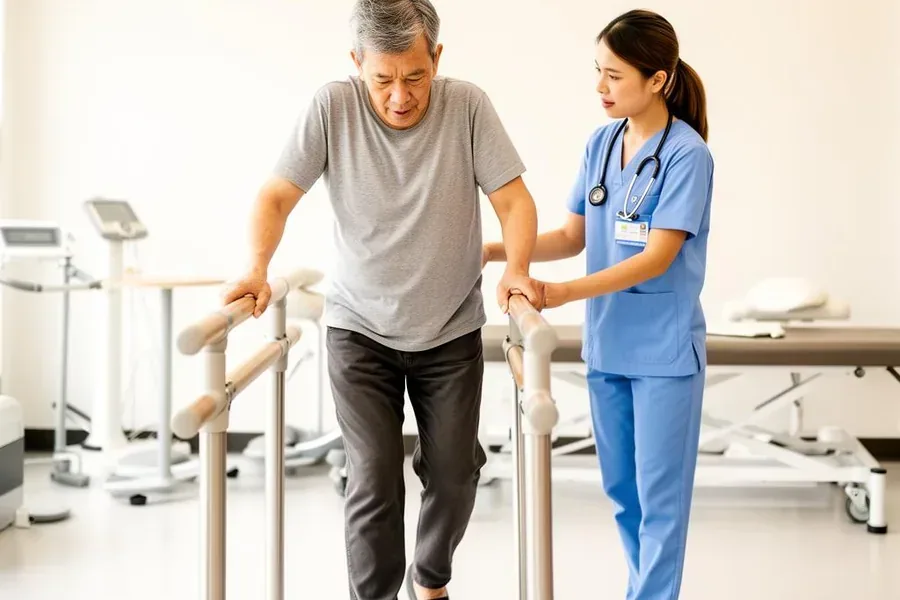
- PT/OT 2-3 sessions/day (6-9 hours/day)
- Task-Specific Training + Constraint-Induced Movement Therapy
- TMS/PMS for cortical priming
- Robotic gait training for non-ambulators
- Average stay 2.6 months — chronic patients typically gain 25-40 Barthel Index points
5. Real Case
A 62-year-old man 14 months post-ischemic stroke, told "this is your recovery" by his previous doctors. After 3 months of intensive Sanpiti rehab: Fugl-Meyer arm score 18 → 42 (+24 points), walking 50 meters with walker (previously wheelchair-only). These cases happen regularly with correct dose.
Frequently Asked Questions
Can I still recover after 1 year?
Yes. Ward et al. (Brain 2019) studied patients averaging 30 months post-stroke and demonstrated significant Fugl-Meyer gains with 90 hours of intensive training. Higher intensity and longer duration are required.
Why did my doctor say recovery has plateaued?
Old statistics from an era without modern intensive rehabilitation, plus resource-limited health systems where most patients receive no ongoing therapy after 6 months. The result becomes a self-fulfilling prophecy.
How many hours per day of training?
For chronic stroke patients, at least 3-4 hours/day for 6-12 continuous weeks (Lohse meta-analysis, Stroke 2014). Intensity is the single most important variable.
Is late rehab more expensive?
Same program, same pricing — starting THB 65,900/month at 8 branches and THB 65,900/month at Jin Wellbeing. Chronic patients often need longer stays to see gains.
It's Never Too Late to Recover
Consult Sanpiti's Late-Recovery Program — even patients years post-stroke can regain function with the correct training intensity.