
Quick Answer
Inpatient multidisciplinary rehabilitation is the single strongest predictor of stroke recovery. The Stroke Unit Trialists' Collaboration (Cochrane 2020, n=13 more than 000) showed organized inpatient care reduces death or dependency by 22%. Sanpiti delivers this model across 9 Bangkok branches with a physiatrist, PT, OT, SLP, RN, and nutrition team — 2 to 3 therapy sessions per day, average stay 2.6 months.
1. Why Inpatient Beats Outpatient for Brain Stroke Recovery
The Stroke Unit Trialists' Collaboration (Cochrane Database Syst Rev 2020) pooled 29 RCTs and confirmed that patients cared for in organized inpatient stroke units are 22% less likely to die or become dependent compared with general wards or home care. The AVERT Trial (Lancet 2015, n=2,104) further showed that starting mobilization within 24 to 48 hours in an inpatient setting improves 3-month outcomes. Outpatient sessions of 1 hour, 2 to 3 times per week cannot reach the dose required for neuroplasticity.
2. What "Multidisciplinary" Actually Means at Sanpiti
A true multidisciplinary rehabilitation team is not just a PT plus a nurse. Each Sanpiti admission is co-managed by:
- Physiatrist (PM&R physician) — weekly rounds, medication and spasticity management
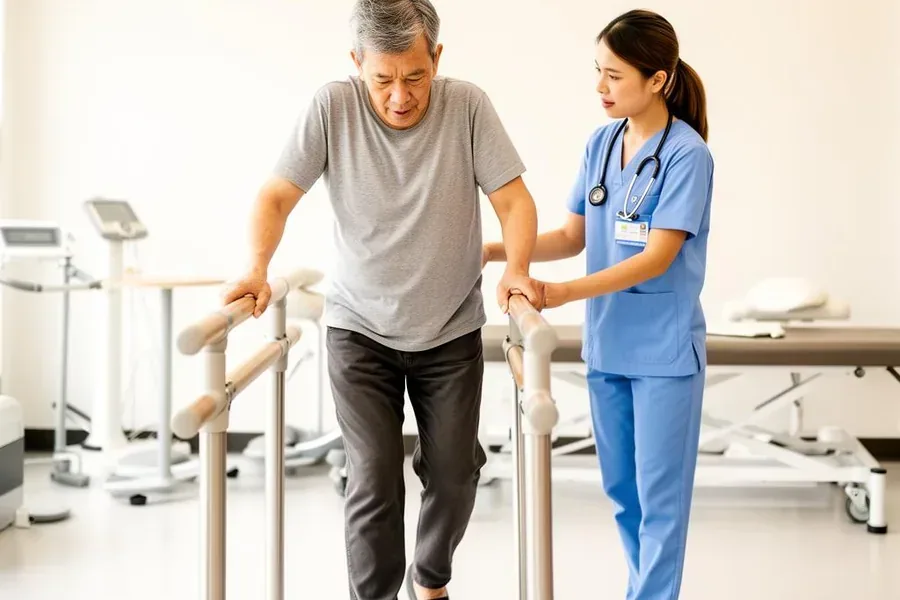
- Physical Therapist (PT) — gait, balance, strengthening, 2 to 3 sessions per day
- Occupational Therapist (OT) — ADL retraining, upper-limb function, Barthel Index tracking
- Speech-Language Pathologist (SLP) — dysphagia, aphasia, cognitive-communication
- Registered Nurse (RN) — 24-hour monitoring, wound and catheter care, medication
- Dietitian — dysphagia diet texture (IDDSI), nutrition for neurorecovery
- Care coordinator — family communication and discharge planning
3. Intensive Daily Therapy — The Dose That Drives Recovery
Lohse et al. (Stroke 2014) meta-analysis proved a clear dose-response relationship: patients receiving more than 17 hours per week of task-specific therapy recover significantly faster. Kwakkel et al. (Lancet 2004) showed that just 20 extra minutes per day of arm training for 20 weeks produced measurable Fugl-Meyer gains. Sanpiti schedules PT and OT 2 to 3 sessions per day, plus adjunctive TMS, PMS, ESWT, FES, mirror therapy, and robotic gait training when indicated.
4. Hospital-Based Safety — Not a Nursing Home
Sanpiti is a hospital-based inpatient rehabilitation model, not an outpatient clinic and not a standalone nursing home. Every branch operates with 24-hour RN coverage, physician oversight, emergency escalation pathways, and infection-control standards. This matters because post-stroke patients have real medical risk: aspiration pneumonia, DVT, recurrent stroke, seizures, and cardiac events. The Bernhardt et al. AVERT analysis (Neurology 2016) confirmed that supervised inpatient early mobilization is safe when medically monitored.
5. Nine Branches Across Bangkok — Choose by Location and Program
Sanpiti operates 9 branches across greater Bangkok so families can visit daily without long commutes — a factor that measurably improves discharge outcomes (Vluggen et al., Clin Rehabil 2020). For international patients, the flagship hospital-integrated Jin Wellbeing program starts at THB 65,900/month as a starting rate. All branches follow the same multidisciplinary protocol led by our founders กภ. กุลฐิณี กลิ่นพูล (กภ.9032) and Dr. Korawlai Glinpoon (ว.53552).
6. What Recovery Looks Like — Sanpiti Outcomes
Across 10+ years and 5,000+ families served, our internal outcomes reflect the international inpatient rehab literature:
- Average length of stay: 2.6 months
- Barthel Index improvement: typically +25 to +40 points during admission
- Majority of admitted patients discharged walking (with or without device)
- Dysphagia rehabilitation with FEES/VFSS-informed protocols
- Continuity to home program and outpatient follow-up
Frequently Asked Questions
Is inpatient rehabilitation really better than outpatient?
Yes. The Stroke Unit Trialists (Cochrane 2020) meta-analysis of 29 RCTs found organized inpatient stroke care reduces death or dependency by 22% vs. general or home care. Outpatient sessions cannot match the required weekly dose.
How long is a typical Sanpiti admission?
The average length of stay is 2.6 months, aligned with international inpatient rehab benchmarks. Chronic-phase patients may stay longer to reach meaningful Fugl-Meyer or Barthel Index gains.
Who leads the multidisciplinary team?
Each admission is co-managed by a physiatrist (PM&R), PT, OT, SLP, RN, and dietitian, coordinated by our founders กภ. กุลฐิณี กลิ่นพูล (กภ.9032) and Dr. Korawlai Glinpoon (ว.53552).
What does the program cost?
For international patients, the flagship Jin Wellbeing hospital-integrated program starts at THB 65,900/month as a starting rate; final pricing is confirmed after clinical assessment.
Is Sanpiti a nursing home?
No. Sanpiti is a hospital-based inpatient rehabilitation center with 24-hour RN coverage, physician oversight, and emergency escalation — not an outpatient clinic and not a standalone nursing home.
Inpatient Multidisciplinary Stroke Rehab, 9 Branches in Bangkok
Talk to the Sanpiti team about admission — hospital-based care, 2 to 3 therapy sessions per day, physiatrist-led.