Why Bangkok Leads Asia in Inpatient Stroke Rehab
Explore why medical tourists choose Bangkok for stroke rehabilitation, combining global clinical standards with compassionate inpatient care.
When a stroke strikes, the immediate crisis happens in the emergency room. Yet the real marathon begins the moment the patient is discharged.
According to the World Health Organization (WHO), 15 million people suffer a stroke worldwide each year. Of those, 5 million are left with permanent disabilities that require intensive, long-term care.
For families in the West, Singapore, Japan, and the Middle East, securing months of daily physical and occupational therapy at home often means facing endless waiting lists or exhausting their life savings. That is exactly why thousands of families are boarding flights to Thailand.
Over the past decade, Bangkok has quietly transformed from a vacation capital into Asia's premier hub for neurological recovery. Here is a look at the data, infrastructure, and economics driving the boom in Bangkok stroke rehab.
The Post-Discharge Bottleneck
According to the American Heart Association and American Stroke Association (AHA/ASA), early and sustained rehabilitation is a primary driver of neuroplasticity—the brain's ability to rewire itself after injury. The brain needs consistent, structured repetition to rebuild motor pathways.
In many developed healthcare systems, acute hospital stays are kept as brief as possible to free up beds. Patients are quickly transitioned to outpatient clinics, where they might only receive therapy a couple of times a week due to therapist shortages or insurance caps.
This creates a frustrating bottleneck right when the brain is most adaptable. Families are suddenly forced to act as full-time nurses at home, navigating complex mobility and swallowing challenges without professional training.
Medical tourism in Thailand solves this capacity problem by offering dedicated inpatient environments where patients can live and train under one roof.
What the Data Says About Thailand's Rise
People used to travel to Thailand primarily for cosmetic procedures or dental work. Today, the healthcare landscape looks completely different.
According to the Deloitte Medical Tourism Report 2023, international patients are increasingly traveling to Southeast Asia for complex, long-term post-acute care and neurological recovery. The report highlights that rising healthcare costs and severe staffing shortages in home countries are pushing families to look abroad for sustainable inpatient solutions.
Quality is no longer a compromise when crossing borders. When you look at Joint Commission International (JCI) Accreditation Data, Thailand consistently leads Southeast Asia in the sheer number of JCI-accredited medical facilities, holding over 60 accredited hospitals and centers.
By combining rigorous international safety protocols like JCI and AACI accreditation with a deep-rooted culture of hospitality, Bangkok has built a healthcare ecosystem specifically tailored for long-term recovery.
This clinical maturity means international patients do not have to choose between rigorous medical governance and accessible daily care. Whether a facility holds JCI or AACI (American Accreditation Commission International) accreditation, families have verifiable proof that infection control, patient safety, and rehabilitation protocols meet global benchmarks.
The Economics of Intensive Recovery
Stroke recovery is rarely a matter of days; it takes weeks and months of dedicated effort. In the United States, Europe, or Australia, paying out-of-pocket for a private inpatient stroke rehabilitation center can cost upwards of tens of thousands of dollars every single month.
In Thailand, lower operational and labor costs allow facilities to invest heavily in human capital. Instead of a single rushed therapist dividing their attention among five patients in a crowded gym, Bangkok centers emphasize dedicated, one-on-one attention.
This economic advantage allows families to extend their stay during the critical early months of recovery without facing financial ruin. Instead of rationing therapy sessions, resources can be directed toward personalized physical therapy, occupational therapy, and swallowing training.
Inside the Bangkok Rehab Model
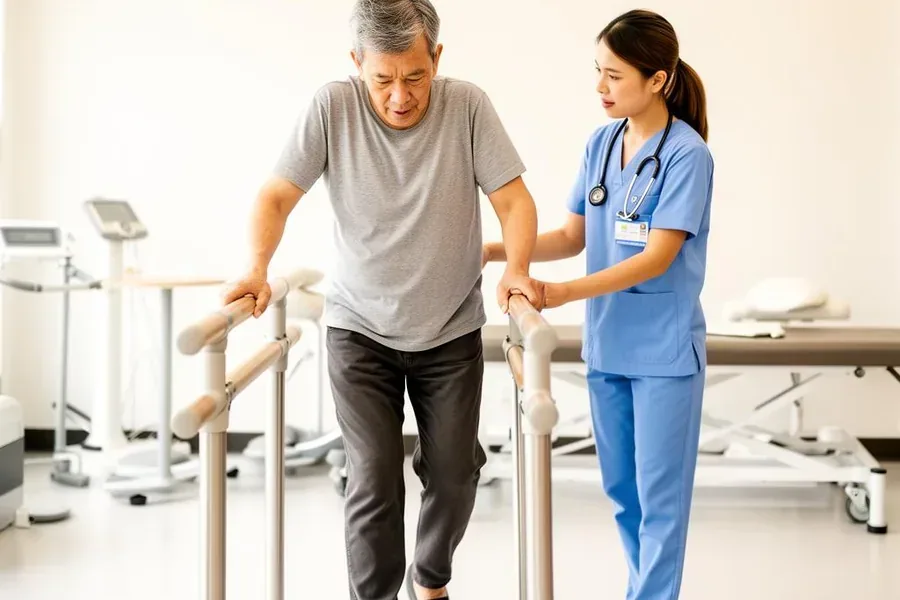
What does this look like on the ground? At Sanpiti Rehabilitation Center in Bangkok, which has served over 5,000 families across 9 branches with more than 10 years of experience, the focus is on bridging the gap between acute hospital discharge and returning home.
Founded by licensed physical therapist Kultinee Glinpoon (Mahidol University, License No. กภ.9032) and physician Dr. Korawlai Glinpoon (License No. ว.53552), the organization built its framework around structured, medically supervised recovery.
At the Jin Wellbeing branch, patients enter a hospital-based inpatient rehabilitation environment backed by AACI accreditation. Base room and care packages start from ฿65,900 per month, while physical therapy, occupational therapy, and other medically assessed treatments are billed separately based on each patient's individual needs.
Because no two strokes affect the brain in the exact same way, therapy intensity is individually assessed by the clinical team rather than sold as a rigid, one-size-fits-all bundle. A patient dealing with post-stroke fatigue requires a very different daily schedule than a patient ready for intensive gait training.
Navigating Logistics and Insurance Abroad
Moving a loved one across borders after a neurological event requires clear financial planning. Unlike acute emergency surgery, long-term inpatient rehabilitation often involves straightforward, transparent payment structures.
When choosing a stroke rehabilitation center in Thailand, international families typically pay the facility directly first. At Sanpiti Rehabilitation Center, for example, there is no direct insurance billing or fax claim service; instead, the administrative team prepares comprehensive medical summaries and itemized receipts so families can submit reimbursement claims to their own insurance providers at home.
Having clear separation between base accommodation costs and assessed therapy charges actually helps families and case managers track expenses accurately. You pay for the exact level of rehabilitation your loved one is physically able to participate in.
Why Environment Matters for the Brain
There is one final factor that clinical data often overlooks: caregiver burnout and patient morale. Recovering in a cold, sterile ward or an unequipped apartment takes a heavy psychological toll on everyone involved.
Thai hospitality—known locally as "Mai Pen Rai" warmth and meticulous service—creates a calm, encouraging atmosphere for patients who are often dealing with frustration and grief after losing their independence. When nursing assistants handle the heavy lifting, bathing, and nighttime repositioning with genuine patience, family members can stop acting as exhausted nurses and go back to being supportive spouses and children.
Choosing a stroke rehabilitation center is ultimately about buying time and expertise during the brain's most critical healing window. Bangkok has become Asia's go-to hub not because it offers magic shortcuts, but because it makes consistent, accredited, hospital-based rehabilitation accessible when families need it most.