The Second Patient: Beating Stroke Caregiver Burnout
Managing stroke caregiver burnout overseas requires smart rest and shared care planning. Learn how stroke rehabilitation in Thailand supports families.
Who is taking care of the person in the bedside chair?
When a loved one survives a stroke, the entire family’s universe shrinks to the size of a single room. Every conversation revolves around swallow tests, blood pressure readings, and whether the left fingers twitched today.
If you have flown across borders to access specialized care, that pressure multiplies. Navigating stroke rehabilitation Thailand offers while living out of a suitcase thousands of miles from your home network is an emotional marathon.
And here is the hard truth most medical pamphlets leave out: if the family caregiver collapses from exhaustion, the patient’s long-term transition back to daily life hits a wall.
The Overseas Pressure Cooker
Dealing with stroke caregiver burnout overseas is uniquely draining because you are stripped of your normal routines. Back home, a neighbor might drop off dinner, or a sibling might take over the afternoon shift so you can nap.
Abroad, you are the advocate, the translator for family back home, the financial coordinator, and the emotional anchor—all while jet-lagged and sleeping in a temporary apartment.
According to the World Health Organization (WHO), stroke is a leading cause of long-term disability globally, which means recovery is rarely a quick sprint. When an inpatient stay stretches from weeks into months, running on pure adrenaline stops working.
Many spouses and adult children feel a quiet, crushing guilt whenever they leave the facility to eat a proper meal or sleep through the night. They treat their own exhaustion as a betrayal of the patient.
What Clinical Evidence Says About Family Support
Clinical authorities have started treating caregiver well-being not as a luxury, but as a core part of the medical playbook. In the UK’s National Institute for Health and Care Excellence guideline, NICE NG236: Stroke rehabilitation in adults (2023), experts explicitly highlight the necessity of involving families and carers in shared care planning.
The NICE NG236 (2023) guidance emphasizes that rehabilitation teams must regularly review the psychological and practical support needs of family members and carers—not just at the beginning, but throughout the recovery journey as the patient's abilities change.
Effective stroke care isn't just about training the patient's muscles; it's about educating, involving, and pacing the family members who will support them long after discharge.
Furthermore, the guideline stresses that before a patient ever leaves an inpatient setting, carers should receive clear information and practical training on how to assist their loved one safely. Separating clinical evidence from everyday habits is crucial here: while guidelines prove that structured family inclusion improves transition readiness, how you manage your daily energy outside the clinic comes down to practical boundaries.
Why a Stroke Rehabilitation Center Exists
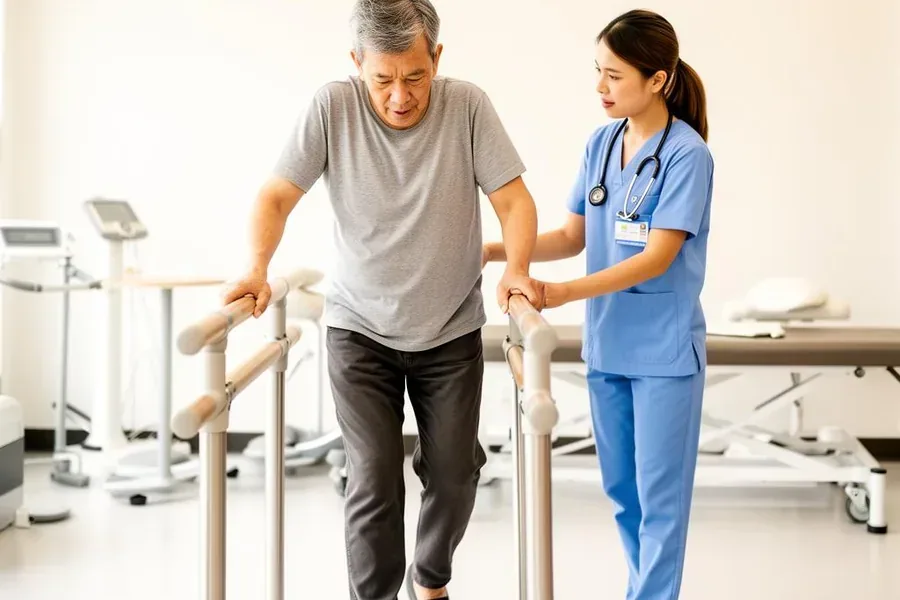
Let’s draw a line between clinical evidence and practical day-to-day survival advice. When you admit a loved one to a dedicated stroke rehabilitation center, you are hiring a professional nursing and therapy team to carry the heavy physical load.
Yet, many family members still act as if they are on 24-hour nursing duty. They stay in the room from dawn until dusk, answering every WhatsApp message from worried relatives back home in real time.
From a practical standpoint, the entire benefit of an inpatient stroke rehabilitation center is that it provides a safe, monitored environment so you can step back and rest. If you burn yourself out during the inpatient phase while nurses are right outside the door, you will have nothing left in the tank when it is time to fly home.
At Sanpiti Rehabilitation Center in Bangkok, which has over 10+ years of experience, 9 branches, and 5,000+ families served, we see this dynamic unfold constantly with both local and international families. Founded by Kultinee Glinpoon (Licensed PT, Mahidol University, License No. กภ.9032) and Dr. Korawlai Glinpoon (License No. ว.53552), our approach centers on structured clinical care that gives families breathing room.
Practical Rules for Pacing a Long Stay Abroad
How do smart families survive a multi-month stay without breaking down? They treat caregiving like a relay race, not a solo marathon.
First, audit your presence during therapy hours. Because every stroke is different, therapy intensity at a stroke rehabilitation center is individually assessed based on what the patient can safely tolerate and benefit from on any given day.
While NICE NG236 (2023) supports involving families in goal-setting and hands-on transfer training, you do not need to hover during every single clinical session unless the therapist invites you in to learn a specific technique. Use those assessed therapy hours to go back to your hotel, sleep, or walk outside.
Second, batch your family updates. Appoint one person back home as the "communications captain" and send one voice note every evening, rather than fielding twenty separate phone calls across three time zones.
Third, get your administrative logistics sorted early so paperwork doesn't eat into your rest time. For example, at Sanpiti Rehabilitation Center’s Jin Wellbeing branch—which provides hospital-based inpatient rehabilitation under AACI accreditation standards—inpatient care starts from ฿65,900/month, with physical therapy, occupational therapy, and other individually assessed treatments charged separately.
For international families managing cross-border finances, knowing the exact billing workflow eliminates a massive source of background stress. Families pay Sanpiti first, and our team issues the formal medical and billing documents you need to submit reimbursement claims to your insurer back home, as we do not do direct insurance billing or fax claims.
Shared Care Planning: Preparing for the Flight Home
The American Heart Association and American Stroke Association (AHA/ASA) have long noted that the transition from inpatient care back to the home environment is one of the most vulnerable periods for both stroke survivors and their caregivers. This is where shared care planning becomes your best defense against burnout.
Instead of sitting passively by the bed for eight weeks and panicking during the final three days before discharge, ask your clinical team to include you in gradual training. Learn how to assist with bed-to-wheelchair transfers safely so you don't injure your own back.
Understand what your loved one can actually do for themselves. Sometimes, over-helping out of love—like feeding a patient who is actively relearning how to hold a spoon during occupational therapy—accidentally slows down their independence and increases your workload.
Choosing a stroke rehabilitation center for a long stay is an investment in professional structure. Let the clinicians handle the medical heavy lifting while you focus on pacing your energy, learning safe care habits, and staying healthy enough to welcome your loved one back to life.
In stroke recovery, taking a four-hour break to sleep isn't abandoning your post—it is maintenance on the most important piece of recovery equipment your loved one has: you.