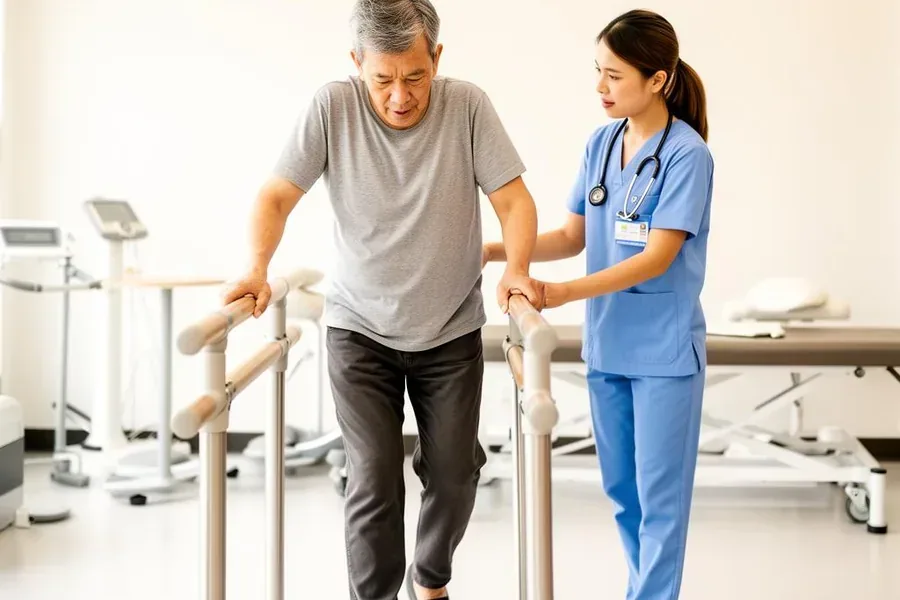
The 12-Month Stroke Recovery Timeline: A Realistic Guide
What does month by month stroke recovery actually look like? Explore the science-backed stroke recovery timeline and how stroke rehabilitation shapes each phase.
Every 40 seconds, someone’s life changes in an instant. According to the World Health Organization (WHO), stroke remains one of the leading causes of long-term disability worldwide, leaving millions of families staring at a hospital bed with the exact same question: "When will they be back to normal?"
If you ask ten different people in a hospital waiting room, you will get ten wildly different answers. That is because the brain does not heal like a broken bone in a cast; it heals by rewiring itself from the inside out.
Understanding the stroke recovery timeline is not about predicting the exact day your loved one will walk again. It is about knowing what the brain is doing behind the scenes during a month by month stroke recovery, so you can give it the exact input it needs at the exact right time.
Days 1 to 7: The Acute Phase and the 'Too Much, Too Soon' Trap
In the first week, the primary battle is medical stabilization in the acute hospital unit. Doctors are focused on blood pressure, brain swelling, and preventing a second stroke.
For years, the conventional wisdom was to get patients out of bed and moving aggressively as soon as humanly possible. Then came the landmark AVERT Trial, published in The Lancet in 2015, which completely reshaped how clinicians view the first 24 hours.
The AVERT Trial studied over 2,000 patients and found that very early, high-dose mobilization within 24 hours of a stroke actually led to less favorable outcomes at three months compared to standard care. The takeaway was clear: while early movement is vital, the injured brain needs brief, frequent, and carefully calibrated activity rather than exhausting marathons right out of the gate.
Month 1: The Brain’s Emergency Cleanup Crew
Once the patient is medically stable and discharged from the acute ward, the real rehabilitation work begins. During Month 1, you might see sudden, surprising improvements—a finger twitching on Tuesday, a leg lifting by Friday.
This rapid shift is partly due to the resolution of "diaschisis"—a fancy medical term for when undamaged parts of the brain go into temporary shock after a stroke. As the swelling goes down and blood flow stabilizes, these stunned brain cells wake back up.
This is typically when families transition from the acute hospital to a dedicated stroke rehabilitation center. In this first month, physical and occupational therapists focus heavily on trunk control, safe swallowing, and early weight-bearing to remind the brain that the affected side of the body still exists.
"Spontaneous neurological recovery is the foundation of the first month, but how you guide that recovery determines how the brain rewires its new pathways."
Months 2 to 3: The Peak Neuroplasticity Window
If Month 1 is the wakeup call, Months 2 and 3 are the heavy construction phase. According to the American Heart Association and American Stroke Association (AHA/ASA), this period represents a critical window of heightened neuroplasticity—the brain's ability to form new neural connections around the damaged area.
How do we know this timeframe is so crucial? Look at the foundational research by Kwakkel et al. (2004), published in the journal Stroke. Their team tracked the time course of functional recovery and found that the steepest curve of improvement in both walking ability and upper limb function occurs within the first 10 to 12 weeks post-stroke.
Kwakkel et al. (2004) also demonstrated that the intensity of therapy during this early window directly influences the speed and degree of functional gains. This is why choosing the right environment for stroke rehabilitation Bangkok families trust is so important during the first quarter of recovery.
At Sanpiti Rehabilitation Center in Bangkok, our team—founded by Licensed Physical Therapist Kultinee Glinpoon (Mahidol University, License No. กภ.9032) and Dr. Korawlai Glinpoon (License No. ว.53552)—has spent over 10 years helping more than 5,000 families navigate this exact window across our 9 branches. At our Jin Wellbeing branch, we provide hospital-based inpatient rehabilitation under AACI accreditation Standards, starting from ฿65,900 per month for accommodation and nursing care, while therapy and other assessed treatments are charged separately based on each patient's clinical evaluation.
Because no two strokes are identical, therapy intensity is individually assessed by the clinical team rather than sold as a one-size-fits-all promise. For families using private medical coverage, families pay Sanpiti first and we issue comprehensive medical and financial documents for reimbursement claims with your insurer.
Months 4 to 6: Navigating Spasticity and the Dreaded 'Plateau'
Around Month 4, the rapid, week-over-week miracles of the early phase begin to slow down. As noted in the recovery curves mapped by Kwakkel et al. (2004) in Stroke, spontaneous biological recovery largely levels off between three and six months.
This is when two things usually happen: muscle spasticity (tightness and involuntary stiffness) often peaks, and families hit an emotional wall known as the "recovery plateau." It is easy to feel discouraged when progress shifts from leaps and bounds to millimeters.
However, a slowdown in spontaneous brain healing does not mean an end to functional progress. In a specialized stroke rehabilitation center, Months 4 to 6 are all about shifting from basic movement to task-specific mastery—learning how to dress, manage stairs, and overcome muscle stiffness through targeted physical therapy.
Months 6 to 12: The Chronic Phase and Redefining Independence
Once a patient crosses the six-month mark, medical literature classifies the condition as the "chronic phase" of stroke. For decades, an old myth circulated that where you are at six months is where you will stay forever.
Modern neuroscience disagrees. While the brain's automatic repair mechanisms have quieted down, experience-dependent plasticity—the exact same mechanism you use to learn a new language or musical instrument—remains active for life.
During Months 6 through 12, the focus of a stroke rehabilitation center shifts toward community reintegration, cognitive stamina, and long-term cardiovascular conditioning. Whether a patient is transitioning home or continuing outpatient sessions at a clinic like Sanpiti Rehabilitation Center in Bangkok, the goal is building sustainable habits that prevent secondary complications and maximize daily independence.
The Hidden Truth About the Timeline
When you zoom out on the entire 12-month stroke recovery timeline, the biggest takeaway is that the brain's biological clock and a person's functional potential are two different things. The first three months are a race to capture the brain's natural healing surge, where structured, medically supervised rehabilitation makes the biggest difference in how the wiring is laid down.
But after Month 6, recovery transforms from a sprint into a craft. When you stop measuring progress against the person your loved one was the day before the stroke—and start measuring it by the skills they are actively rebuilding every week—you realize the timeline doesn't end at Month 12; it just changes how it keeps score.