Hospital vs. Specialized Rehab: Your Stroke Recovery in Bangkok
Navigating stroke recovery options in Bangkok? Explore the pros and cons of hospital vs. specialized rehab centers like Sanpiti for international patients.
A stroke can be a life-altering event. For international patients seeking rehabilitation, the journey often begins after acute medical stabilization. The crucial decision then becomes: where is the best place to continue recovery? You'll likely face a choice between long-term hospitalization and a dedicated, specialized stroke rehabilitation center. In Bangkok, a hub for world-class medical tourism, understanding these options is paramount for optimizing outcomes.
At Sanpiti Rehabilitation Center (แสนปิติ), we frequently encounter this dilemma. Our goal is to provide clear, evidence-based information to help you make an informed decision for your or your loved one's stroke recovery journey, especially if you're considering Bangkok, Thailand, for your rehabilitation needs.
The Acute Phase: Hospitalization and Initial Care
Immediately after a stroke, acute care in a hospital setting is indispensable. This phase focuses on stabilizing the patient, minimizing brain injury, and preventing complications. Hospitals in Bangkok offer excellent emergency services, neuro-imaging, and acute stroke units. During this stage, a multidisciplinary team, including neurologists, intensivists, and often physical therapists, assesses the extent of damage and initiates early mobilization.
The American Heart Association/American Stroke Association (AHA/ASA) guidelines emphasize early rehabilitation initiation within 24-48 hours post-stroke for medically stable patients, even if brief, to prevent deconditioning and improve long-term outcomes.
However, once stable, the focus shifts from acute medical management to intensive rehabilitation. This is where the distinction between a general hospital ward and a specialized rehabilitation center becomes critical.
Option 1: Continuing Rehabilitation in a Hospital Setting
Some hospitals offer inpatient rehabilitation services. For international patients, remaining in a familiar hospital environment might seem convenient, especially if initial treatment was received there.
Pros of Hospital Rehabilitation:
Immediate Medical Access: Round-the-clock access to doctors, nurses, and emergency medical equipment, which can be reassuring for patients with complex medical comorbidities.,Integrated Care: For patients requiring ongoing diagnostic tests or specialist consultations (e.g., cardiology, nephrology), a hospital setting simplifies coordination.,Continuity: Remaining in the same facility can provide a sense of continuity for some patients and families.
Cons of Hospital Rehabilitation:
Rehabilitation Focus: While hospitals provide rehabilitation, it's often not their primary focus. The intensity and specialization of therapy sessions may be lower compared to dedicated centers. A study published in Stroke found that patients in specialized rehabilitation units receive more therapy hours per day than those in general hospital wards (Dobkin & Dorsch, 2011).,Environment: Hospitals, by nature, are often clinical and can be less conducive to long-term psychological well-being. The environment might lack dedicated spaces for independent practice or community re-integration activities.,Cost: Extended hospital stays, especially in private international hospitals, can be significantly more expensive in the long run without providing the same intensity of specialized therapy.,Limited Specialization: General hospital therapists may have broader expertise but might lack the deep, specific experience in advanced neurorehabilitation techniques that specialized centers offer. Sanpiti's founders, Kultinee Glinpoon (Licensed PT, Mahidol University) and Dr. Korawlai Glinpoon (PM&R Physician), exemplify this dedicated specialization.
Option 2: Specialized Stroke Rehabilitation Centers
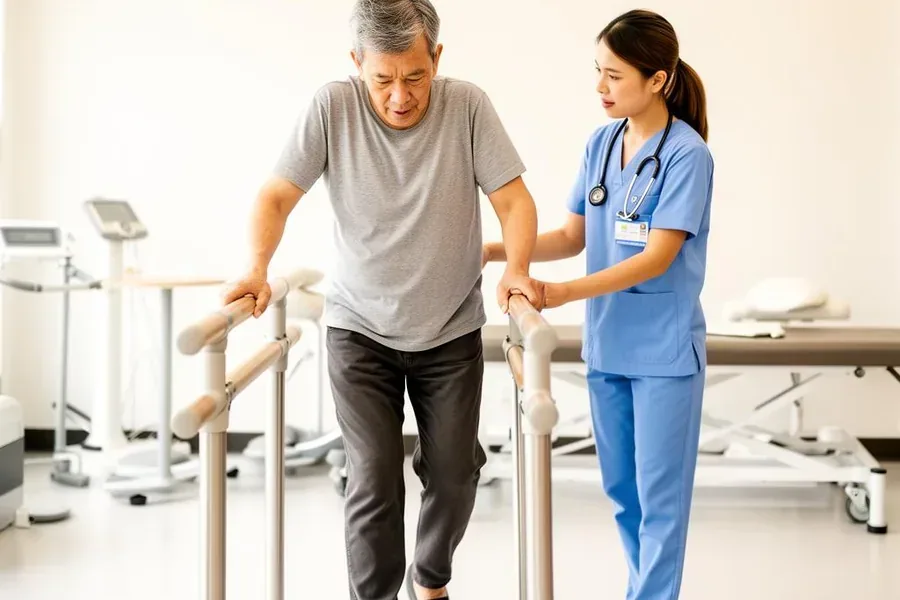
Specialized stroke rehabilitation centers, like Sanpiti, are purpose-built facilities designed to maximize functional recovery after a stroke. They operate on the principle of intensive, multidisciplinary rehabilitation.
Pros of Specialized Stroke Rehabilitation Centers:
Intensive, Focused Therapy: This is the cornerstone. Patients receive significantly more hours of therapy per day. At Sanpiti, for example, patients typically engage in 2-3 physical therapy sessions per day, customized for their individual needs. Evidence overwhelmingly supports that higher intensity and frequency of therapy lead to better outcomes (Kwakkel et al., 2004, The Lancet).,Neuroplasticity-Based Training: Our programs are steeped in the principles of neuroplasticity – the brain's ability to reorganize itself to compensate for injury. This involves repetitive, task-specific training, constraint-induced movement therapy, mirror therapy, and advanced technologies to rewire neural pathways.,Multidisciplinary Team: Dedicated teams including physical therapists, occupational therapists, speech-language pathologists, neuropsychologists, and rehabilitation physicians (like Sanpiti's Dr. Korawlai Glinpoon) who specialize only in rehabilitation cases. This integrated approach ensures all aspects of recovery are addressed.,Optimized Environment: Centers are designed to mimic real-life situations, with obstacle courses, simulated home environments, and accessible community spaces to prepare patients for discharge. The environment is often calmer and more focused on recovery than a bustling hospital.,'Golden Period' Expertise: The first few months post-stroke are often referred to as the 'Golden Period' where the brain's capacity for recovery is highest. Specialized centers are adept at harnessing this window with intensive, targeted interventions.,Better Patient Outcomes: Numerous studies, including a Cochrane review, indicate that organized inpatient stroke care in specialized units leads to higher rates of independence and reduced mortality compared to conventional care units (Stroke Unit Trialists' Collaboration, 2013). Sanpiti's 87% recovery success rate is a testament to this specialized approach, with recovery defined as regaining functional independence for daily activities.,Cost-Effectiveness for International Patients: While high-quality, specialized care is invaluable, rehabilitation in Bangkok, Thailand, is significantly more cost-effective compared to Western countries. Sanpiti offers comprehensive programs starting from $850 per month, making world-class rehabilitation accessible to a wider international audience without compromising on quality or intensity. Sanpiti also boasts 9 branches across Bangkok, offering convenience and accessibility.,Community and Support: Patients often benefit from peer support and a shared sense of purpose in a rehabilitation setting, fostering a positive recovery mindset.,Family Integration: Centers often have more flexible visitation and family involvement programs, crucial for long-term recovery and transition back home.
Cons of Specialized Stroke Rehabilitation Centers:
Medical Acuity: Patients requiring intensive medical monitoring or frequent acute interventions might be better suited for acute hospital settings initially. However, specialized rehab centers like Sanpiti have protocols for medical emergencies and often have affiliations with nearby hospitals.,Initial Transition: The move from an acute hospital to a rehab center requires coordination, but experienced international patient services (which Sanpiti provides) smooth this transition.
Actionable Advice for International Patients: Choosing Wisely
When considering your stroke rehabilitation options in Bangkok, ask yourself and your medical team these crucial questions:
Severity of Medical Needs: Does the patient still require intensive medical monitoring for unstable conditions (e.g., uncontrolled blood pressure, severe heart conditions)? If so, an extended hospital stay might be necessary until these are stable.,Rehabilitation Goals: What are the primary recovery goals? Is it regaining lost motor function, improving speech, or returning to independent living? Specialized centers are geared towards functional gains.,Intensity of Therapy: How many hours of targeted, individualized therapy will be provided daily? Aim for at least 3 hours of therapy per day, 5-6 days a week, as recommended by leading neurological rehabilitation guidelines.,Team Expertise: Is the rehabilitation team comprised of specialists specifically in neurological rehabilitation? Do they understand principles of neuroplasticity and utilize evidence-based techniques?,Duration of Recovery: Stroke recovery is a marathon, not a sprint. Consider a center that can accommodate longer stays if needed and provides a clear progression pathway.,Cost vs. Value: While cost is a factor, weigh it against the intensity and quality of care. A seemingly cheaper option might offer fewer therapy hours, leading to prolonged recovery or suboptimal outcomes. Thailand offers exceptional value for money in this regard.
Why Sanpiti Rehabilitation Center Stands Out for International Patients
At Sanpiti, our model is explicitly designed to meet the advanced rehabilitation needs of stroke patients, offering a compelling alternative to prolonged general hospital stays. With Kultinee Glinpoon (Licensed PT, Mahidol University) and Dr. Korawlai Glinpoon (PM&R Physician) at the helm, our centers embody expertise and a patient-centric approach.
Proven Success: Our 87% recovery success rate reflects our commitment to intensive, evidence-based neurorehabilitation.,Intensive Therapy: We prioritize frequent, high-quality therapy, with 2-3 PT sessions per day, supplemented by OT and SLP as needed.,Neuroplasticity Focus: Our programs are specifically designed to leverage the brain's ability to adapt and heal.,Extensive Network: With 9 branches across Bangkok, we offer convenient access and a robust support system.,Affordable Excellence: World-class rehabilitation is accessible, starting from $850 per month, making us a highly attractive option for international medical tourists. This makes our stroke rehab options in Bangkok highly competitive.,The Golden Period: We excel in maximizing recovery during this critical phase, offering the focused care needed for optimal results.
The choice between a hospital and a specialized rehabilitation center for stroke recovery is pivotal. For international patients seeking the best possible outcomes in Bangkok, a specialized center like Sanpiti offers an unparalleled environment for intensive, evidence-based, and compassionate care, ultimately paving the way for a more independent and fulfilling life post-stroke.