Hospital-Based Stroke Rehab: The Hidden ER Advantage
Why does location matter in stroke rehabilitation? Discover the clinical safety of hospital-based stroke rehab vs. standalone clinics in Bangkok.
What happens if a stroke survivor has a sudden blood pressure spike at 2:00 AM during their second week of physical therapy?
If they are in a standalone clinic or a converted house, the staff calls an ambulance. Then, everyone waits while precious minutes tick away in city traffic.
If they are inside a hospital-based stroke rehab facility, the emergency response happens down the hall—not across town. When you are rebuilding a brain after a neurological crisis, real estate isn't just about comfort; it is a critical clinical safety net.
The Illusion of 'Medically Stable'
When a hospital discharges a stroke patient, doctors use the phrase "medically stable." To most families, that sounds like the danger has passed and the hard medical part is over.
In reality, the first few weeks after a stroke are a physiological tightrope walk. According to the American Heart Association/American Stroke Association (AHA/ASA), post-stroke patients remain vulnerable to secondary complications—including aspiration pneumonia, deep vein thrombosis, cardiac arrhythmias, and recurrent strokes.
Recovery requires pushing the body physically to trigger neuroplasticity. Yet, pushing a fragile cardiovascular system requires serious medical oversight.
This is where the fundamental divide in post-stroke care appears: standalone facilities versus a hospital-based stroke rehabilitation center.
What the Data Says About Organized Hospital Care
For decades, researchers have asked a simple question: Does the environment where a stroke patient recovers actually change their outcome?
The answer is an overwhelming yes. In a landmark systematic review by the Stroke Unit Trialists' Collaboration, published in the Cochrane Database of Systematic Reviews (2013), researchers analyzed data from thousands of patients to compare organized inpatient stroke unit care against general wards or less integrated setups.
Patients who received organized inpatient care in a dedicated stroke unit were significantly more likely to be alive, independent, and living at home one year after their stroke. — Stroke Unit Trialists' Collaboration (Cochrane, 2013)
Seven years later, Langhorne et al. (2020) confirmed these findings in an updated Cochrane review. They demonstrated that the benefits of organized, multidisciplinary inpatient stroke care are robust, enduring, and directly linked to how well medical and rehabilitation teams coordinate under one roof.
Notice the keyword: multidisciplinary coordination. It is not just about having a great physical therapist; it is about having that therapist work inside a medical ecosystem where nursing, diagnostics, and emergency care intersect.
Standalone Clinic vs. Hospital-Based Stroke Rehab
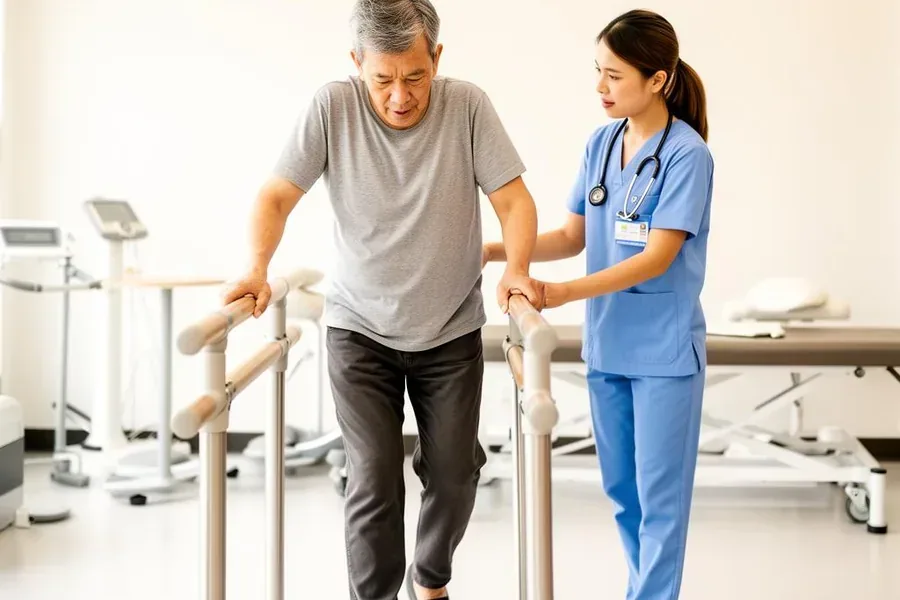
Walk into a luxury standalone nursing home or rehab villa, and it might look like a five-star hotel. The gardens are lush, the lobby smells like lemongrass, and the gym has shiny parallel bars.
However, look behind the curtain for the clinical infrastructure. Does that standalone building have an on-site laboratory to run urgent blood panels when a patient seems unusually lethargic? Is there radiology down the elevator shaft if a patient develops a sudden cough or needs an urgent brain scan?
In a standalone stroke rehabilitation center, any medical hiccup disrupts the entire recovery rhythm. The patient must be packed into an ambulance, transported to an external hospital, admitted through a busy ER, and evaluated by doctors who do not know their baseline rehab progress.
Inside a hospital-based setting, that friction disappears. Immediate access to an Emergency Room (ER), diagnostic imaging, and pharmacy support means minor medical fluctuations are caught and managed before they derail weeks of hard-earned physical therapy.
Why Therapists Can Work More Confidently
There is a psychological side to hospital-based safety that nobody talks about: therapist confidence.
According to World Health Organization (WHO) rehabilitation guidelines, early and structured mobilization is essential for regaining function after a stroke. However, if a physical therapist is working in an isolated standalone clinic without hospital backup, they naturally play defense.
If a patient’s heart rate climbs or they feel slightly dizzy during gait training, an isolated therapist might stop the session completely out of caution. Conversely, in a hospital-based stroke rehab environment, the clinical team has the diagnostic backing and medical infrastructure to assess the patient properly and safely adapt the therapy.
Safety doesn't slow down intensive rehabilitation. Safety is what makes active rehabilitation possible in the first place.
Decoding AACI Accreditation in Bangkok
When families search for an AACI accredited stroke center Bangkok offers several medical options, yet understanding what that accreditation means is vital. AACI stands for the American Accreditation Commission International—one of the world's most stringent healthcare quality standards.
An environment backed by AACI accreditation standards doesn't rely on guesswork. Everything from infection control and medication management to emergency transfer protocols and fall prevention is audited against international clinical benchmarks.
At Sanpiti Rehabilitation Center in Bangkok, this philosophy shapes how we approach complex stroke recovery. Founded by Kultinee Glinpoon (Licensed PT, Mahidol University, License No. กภ.9032) and Dr. Korawlai Glinpoon (License No. ว.53552), Sanpiti has spent over 10 years serving more than 5,000 families across 9 branches.
For families seeking hospital-grade security, our Jin Wellbeing branch operates as a hospital-based inpatient rehabilitation facility within an AACI-accredited healthcare environment. Inpatient stays there start from ฿65,900 per month, while physical therapy, occupational therapy, and other clinically assessed treatments are charged separately based on each patient's individual evaluation.
Because every stroke affects the brain differently, therapy intensity is individually assessed rather than sold as a one-size-fits-all promise. For families using private health coverage, families pay Sanpiti first, and our team prepares the necessary medical documentation so you can submit reimbursement claims to your insurer directly.
The Questions to Ask Before You Choose
When you are touring a stroke rehabilitation center for someone you love, do not just look at the bedroom view or the treadmill in the gym. Look at the clinical safety net underneath them.
Ask the admissions team three direct questions: How many minutes does it take to reach an Emergency Room if my parent has a medical crisis? Can we get lab work or imaging done without leaving the complex? And how do the medical staff and physical therapists communicate daily?
The brain has a remarkable capacity to rewire itself after a stroke, as the research by Langhorne et al. (2020) continues to remind us. However, neuroplasticity thrives best when the body is protected—and sometimes, the smartest rehabilitation technology is simply being inside the right hospital walls.