Cross-Border Care: Setting Real Stroke Rehab Goals Abroad
Planning overseas care? Discover how to set meaningful, evidence-based goals with an international stroke rehabilitation center.
What happens when a life-changing medical emergency strikes thousands of miles away from the family members who have to manage the aftermath?
Imagine boarding a long-haul flight after a sudden phone call, landing in a foreign country, and walking into a clinical meeting jet-lagged and overwhelmed. When you sit down with an overseas medical team, the first question they ask is simple, yet massive: What are our goals?
For most families, the immediate answer is just one word: "Everything." They want their loved one to walk, talk, and return to their exact pre-stroke life by next Tuesday.
While that ambition is completely understandable, clinical recovery requires a much sharper blueprint. Whether you are coordinating care from across an ocean or sitting right by the bedside, knowing how to set structured, meaningful targets with a stroke rehabilitation center is the secret to turning vague hope into measurable daily action.
Why "Getting Better" Isn't a Clinical Strategy
According to the World Health Organization (WHO), stroke remains one of the leading causes of long-term adult disability worldwide, often leaving survivors with a complex mix of motor, speech, and cognitive challenges. Because every brain injury is entirely unique, a generic exercise routine simply does not work.
When a patient enters a specialized stroke rehabilitation center—often searched locally in Thailand as a ศูนย์ฟื้นฟูหลอดเลือดสมอง—their brain is attempting to rewire itself through neuroplasticity. However, neuroplasticity thrives on specificity.
Telling a physical therapist you want to "get stronger" is like telling a taxi driver you want to "go somewhere nice." Without a precise destination, nobody knows which route to take or how to measure whether you are actually getting closer.
The NICE Standard: What the Evidence Says About Goal-Setting
To understand how world-class clinical teams build a recovery roadmap, we can look directly at UK clinical standards. Specifically, the National Institute for Health and Care Excellence guideline, NICE NG236 Stroke rehabilitation in adults (2023), published at <a href="https://www.nice.org.uk/guidance/ng236" target="blank" rel="noopener noreferrer"NICE NG236: Stroke rehabilitation in adults</a, lays out a clear framework for how multidisciplinary teams and families should collaborate.
The NICE NG236 (2023) guidelines emphasize that rehabilitation goals must be agreed upon collaboratively with the person who has had a stroke—and, where appropriate, their family or carers. Rather than doctors dictating a rigid checklist from on high, goal-setting is designed to be a shared conversation.
According to NICE NG236 Stroke rehabilitation in adults (2023), rehabilitation goals should be meaningful, focused on activity and participation, challenging yet achievable, and supported by agreed time points for review.
Notice the distinction in that guideline: goals should focus on activity and participation, not just isolated body parts. Instead of an abstract clinical metric like "increase left knee flexion," a meaningful goal sounds like "safely transfer from the bed to a wheelchair with minimal assistance so I can eat dinner at the table."
Furthermore, NICE NG236 (2023) highlights the necessity of having both short-term and long-term targets. You need the big-picture horizon to keep motivation high, and you need the immediate weekly stepping stones so the therapy team can adjust treatments based on real-time progress.
Bridging the Distance for International Families
When families are split across time zones, the NICE framework of shared priorities and scheduled review dates becomes even more critical. If a son or daughter is flying back to Europe or Australia after setting up initial care in Bangkok, everyone needs a unified communication rhythm.
First, align on patient priorities before looking at medical charts. Does the patient live in a two-story house with stairs? Were they an avid cook before the stroke? Do they need enough sitting balance to tolerate an international flight home in the future? Sharing these real-life environmental details helps an overseas team tailor therapy sessions to the actual life the patient is returning to.
Second, establish realistic review dates on the calendar. Recovery after a brain injury is rarely a straight line; it involves plateaus, sudden breakthroughs, and days when fatigue takes over. Setting a formal review date every couple of weeks allows the clinical team, the patient, and family members joining via video call to look at objective progress and reset the next milestone together.
At Sanpiti Rehabilitation Center in Bangkok, which operates as a hospital-based inpatient rehabilitation provider with 9 branches, over 10 years of experience, and more than 5,000 families served, clinical teams led by founders Kultinee Glinpoon (Licensed PT, Mahidol University, License No. กภ.9032) and Dr. Korawlai Glinpoon (License No. ว.53552) assess each patient individually to build these structured care plans. Because therapy intensity and specific medical treatments are always determined by individual clinical assessment rather than a one-size-fits-all template, clear family communication is the anchor of the entire process.
Provider-Published Patient Experience: Paul's Recovery Journey
To see how personal priorities—like regaining mobility after an unexpected crisis abroad—play out in real life, we can look at a provider-published patient experience video shared on YouTube at <a href="https://www.youtube.com/watch?v=n4j12fWjYBg&t=40s" target="blank" rel="noopener noreferrer"Watch Paul’s recovery story on YouTube</a, titled "Sanpiti stroke rehabilitation Thailand Walking Again After Stroke: Paul's Recovery Journey" (YouTube upload date: 2026-10-05; note that this reflects the platform's listed upload date rather than a separately verified publication date).
In the video, Paul explains in his own words that he is from England and has lived in Thailand for 12 years. When a stroke suddenly disrupted his life expat-style, the cross-border family network immediately kicked into gear: Paul reports that his daughters travelled from England after his stroke and found Sanpiti online while searching for a place to support his rehabilitation.
For Paul, the overarching personal priority was unmistakable—getting back on his feet. Reflecting on where he started and the milestone that mattered most to him during his stay at the stroke rehabilitation center, he sums up his functional focus in three simple, powerful words:
"I can walk."
It is important to frame this story accurately for families researching their options: this video represents Paul's own personal testimony published by the provider, rather than a direct family interview, an independent third-party review, or generalized clinical evidence. Every stroke survivor starts from a different neurological baseline, and one patient's personal reflection is not a guarantee of specific recovery outcomes for someone else.
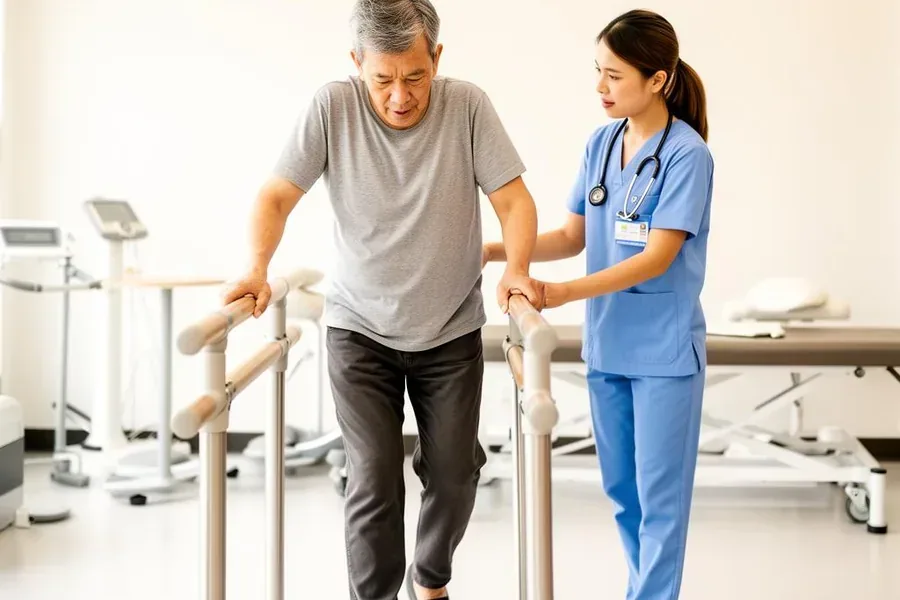
What Paul's story does illustrate, however, is the human reality behind international care coordination. Note also that any decorative cover illustration accompanying this article is conceptual and does not depict Paul.
How to Prepare for Your First Care Conference
If you are currently helping a loved one transition from acute hospital care into a dedicated stroke rehabilitation center overseas, you do not need a medical degree to advocate for them effectively. You just need to bring the right context to the table.
Start by writing down three non-medical facts about your loved one's daily routine before the stroke, alongside one practical boundary—such as travel timelines or how your family handles administrative logistics. For instance, if you are organizing international finances, knowing early on that families pay Sanpiti first and receive official documentation to submit their own reimbursement claims helps you align your administrative timeline with your clinical review dates.
Most importantly, make sure the patient's own voice stays at the center of the room. Even if aphasia or fatigue makes communication slow, NICE NG236 (2023) reminds us that supporting the individual to participate in their own goal-setting is foundational to dignified care.
The ultimate takeaway for international families is this: good rehabilitation isn't something that is simply done to a patient in a gym. It is a partnership built on clear, honest milestones—where a care team's clinical expertise meets the specific, everyday life a survivor is fighting to reclaim.