Bed-to-Chair Transfers After Stroke: The Safety Blueprint
Moving from bed to chair after a stroke looks simple, yet carries hidden risks. Learn how stroke rehabilitation plans safe caregiver transfers.
How hard can it be to move someone three feet from a mattress to an armchair?
Before a neurological event, the transition from sleeping to sitting happens on autopilot. Your core engages, your feet plant, your knees hinge, and gravity stays quietly in the background.
After a stroke, those three feet can feel like crossing a canyon. According to the World Health Organization (WHO), stroke remains one of the leading causes of acquired adult disability worldwide, turning everyday micro-movements into high-stakes biomechanical puzzles.
For international families suddenly navigating post-stroke care—often far from home or evaluating options for stroke rehabilitation Thailand—mastering stroke bed chair transfer safety is not about muscling through. It is about clinical strategy.
Why You Won't Find a 'DIY Transfer Tutorial' Here
If you search the internet for how to move a loved one after a stroke, you will find thousands of cheerful step-by-step videos. Put your arm here, pivot there, and voila.
Here is the clinical reality: copying a generic transfer video at home without an individual physical assessment is a recipe for two patients instead of one.
Every stroke affects the brain differently. One person may have flaccid weakness on their left side, while another deals with high muscle tone (spasticity), Pusher syndrome (where the brain mistakenly pushes toward the weak side), or spatial neglect.
Because of these invisible neurological variables, this article is strictly not an unsupervised transfer tutorial. Instead, let's look at the clinical evidence behind how medical teams actually plan safe assistance—and what practical steps families should demand before ever attempting a transfer on their own.
The Hidden Danger of the 'Underarm Pull'
When a loved one starts to slide or struggles to stand from the edge of the bed, human instinct kicks in. Family members almost always reach under the patient's armpits and pull upward.
In physical therapy circles, this instinct makes clinicians wince.
As the American Heart Association and American Stroke Association (AHA/ASA) frequently note in their patient care resources, the human shoulder joint is held in its socket primarily by a cuff of muscles and tendons. When a stroke weakens those muscles, the heavy arm bone can begin to droop out of the socket—a painful condition called shoulder subluxation.
Pulling on or lifting under a stroke-affected arm puts extreme traction on soft tissues that have no muscular armor left to protect them. Meanwhiles, the caregiver absorbs massive shear forces right into their own lower lumbar spine.
Safe transfers are never about lifting weight with your back; they are about clinical assessment, weight-shifting mechanics, and protecting vulnerable joints.
What the Evidence Says: NICE NG236 (2023)
To separate well-meaning guesswork from clinical science, we can look at one of the most comprehensive frameworks in modern medicine: the National Institute for Health and Care Excellence guideline, NICE NG236: Stroke rehabilitation in adults, updated in October 2023.
The NICE NG236 guideline makes it clear that getting out of bed and into a chair is not just custodial care. Early, supported sitting and transferring are core pieces of neurological rehabilitation that help restore postural control and prevent complications of immobility.
However, the evidence in NICE NG236 emphasizes that movement and handling must begin with a formal, individualized assessment by qualified clinicians. Before anyone chooses a transfer method, the multidisciplinary team evaluates trunk stability, cognitive readiness, blood pressure changes upon sitting (orthostatic hypotension), and limb tone.
Crucially, the 2023 NICE guidance also highlights two pillars for ongoing safety: prescribing specifically assessed assistive equipment and providing structured, hands-on training to family members and carers before they take on physical assistance duties.
The Gear: Why Equipment Must Be Clinically Matched
Walk into a medical supply store, and you will see transfer boards, gait belts, pivot discs, and mechanical hoists. Buying them off the shelf without a therapist's input is like buying prescription glasses based on how cool the frames look.
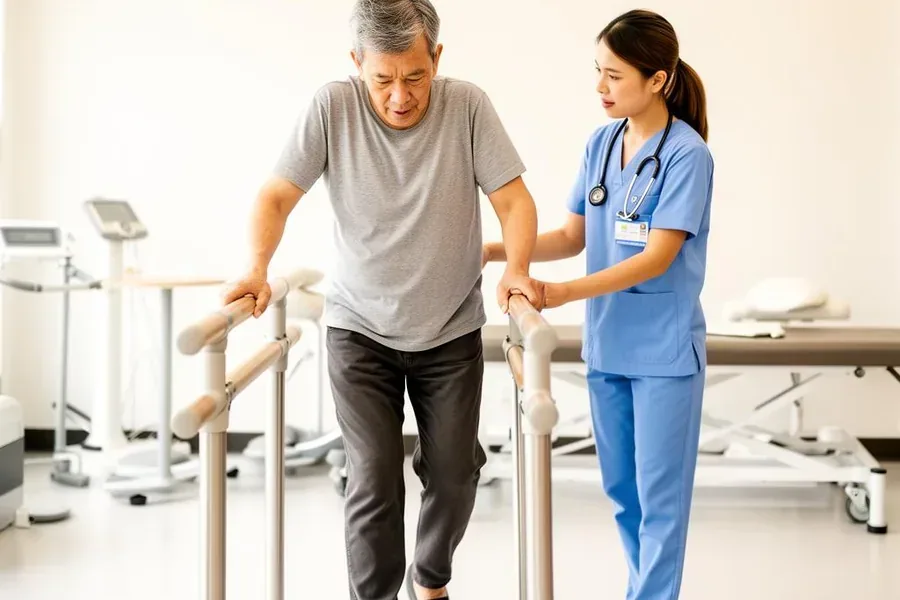
At a specialized stroke rehabilitation center, physical and occupational therapists match equipment to the exact stage of motor recovery.
For instance, a mechanical hoist (sling lift) might be required early on if a patient cannot bear weight through their legs or stay alert enough to participate. As trunk control improves, a therapist might assess the patient for a sliding transfer board or a guided sit-to-stand pivot using a gait belt.
Even the chair itself requires an assessment. A low, deep, plush sofa at home may feel cozy, but biomechanically it is a trap for someone with hemiparesis. Clinicians look at seat height, firm armrests, wheel locks, and cushion support to ensure the destination is just as safe as the journey.
Practical Advice vs. Clinical Evidence: A Checklist for Families
While clinical evidence (like NICE NG236) dictates how medical teams assess tone, balance, and transfer readiness, families also need practical operational habits when visiting a ward or preparing for discharge.
First, never guess a patient's current transfer status. Ability can fluctuate between morning and evening due to post-stroke fatigue or medication changes. Always ask the therapy team what level of assistance—and how many people—are required today.
Second, insist on hands-on caregiver training. Watching a therapist perform a seamless transfer is like watching a pro golfer swing; it looks effortless until you try it yourself. Guided practice under a physiotherapist's eye teaches you where to place your feet, how to protect the weak shoulder, and how to cue the patient to do their share of the work.
Third, audit the environment before moving. Are both the bed brakes and wheelchair brakes locked? Are footrests swung completely out of the way so they do not slice fragile shins? Is the patient wearing non-slip footwear rather than loose hospital socks?
How Hospital-Based Care Bridges the Gap
For international families traveling for stroke rehabilitation Thailand, coordinating medical oversight, equipment selection, and family education can feel overwhelming.
This is where choosing an established stroke rehabilitation center makes a tangible difference in daily safety. Founded by Kultinee Glinpoon (Licensed PT, Mahidol University, License No. กภ.9032) and Dr. Korawlai Glinpoon (License No. ว.53552), Sanpiti has over 10+ years of experience, operates 9 branches, and has supported 5,000+ families through complex recovery transitions.
At Sanpiti Rehabilitation Center in Bangkok, every inpatient is evaluated individually before a transfer plan is put into action. Therapy intensity and handling methods are never one-size-fits-all; they are clinically assessed based on the patient's neurological stability and physical stamina.
At our Jin Wellbeing branch, families have access to hospital-based inpatient rehabilitation within a setting backed by AACI accreditation. Base accommodation and nursing care start from ฿65,900/month, while physical therapy, occupational therapy, and other assessed medical treatments are charged separately according to each patient's personalized care plan.
For international families managing cross-border healthcare budgets, transparency is key: families pay Sanpiti directly first, and our administrative team prepares the necessary medical and financial documentation so you can submit reimbursement claims to your insurance provider.
The Takeaway: A Transfer Is Therapy in Disguise
Here is the most empowering shift in mindset you can make at a stroke rehabilitation center: moving from bed to chair is not just logistics to get someone to the breakfast table.
When planned by a physical therapist, supported with the right equipment, and executed safely by trained caregivers, every single transfer becomes a functional repetition for the brain.
Skip the internet shortcuts, protect that vulnerable shoulder, and lean on your clinical team at a dedicated stroke rehabilitation center to turn those three feet between bed and chair into the safest step of the day.